
Most AI projects stall not because the model is bad, but because it was dropped into a broken process and expected to absorb the chaos. Here’s what’s actually going wrong – and what to fix first.
Every week I talk to a founder or ops lead who says some version of the same thing: “We tried AI, it didn’t really work.” When I ask what they tried, the answer is almost always a tool. ChatGPT. Copilot. Some workflow automation platform. And when I ask what process the tool was supposed to fit into, there’s a pause.
That pause is the problem.
Companies are evaluating AI tools the way they used to evaluate software: find a tool that looks right, buy a subscription, see if adoption happens. But AI assistants are not software in the traditional sense. They don’t slot into a gap. They amplify whatever is already there – including the mess.
The pattern I keep seeing: A team with undocumented, partially tribal, Slack-and-spreadsheet-dependent workflows adds an AI layer on top. The AI produces inconsistent results. The team concludes the AI is not ready. The actual problem was never the AI.
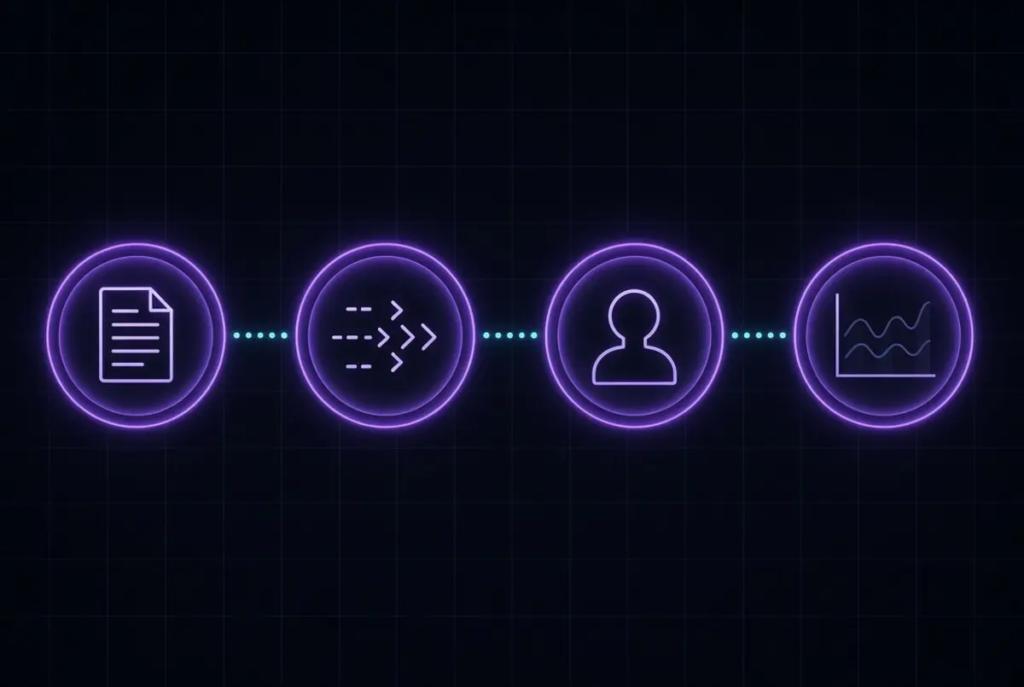
Four things that actually cause AI projects to fail
No process documentation
The AI cannot follow a process that lives only in someone’s head. If you cannot describe the steps in writing, you cannot automate them.
Broken data flows
Information moves through email threads, Slack DMs, and disconnected spreadsheets. The AI gets fragments. Fragments produce garbage.
No output owner
Someone asked the AI to produce something. Nobody was assigned to review, correct, or act on what it produced. The output just sits there.
Wrong success metric
“The team should use it more” is not a metric. If you don’t know what time or cost the AI is supposed to reduce, you can’t tell if it’s working.
What this looks like in practice
Here’s a composite example from a real type of engagement. A marketing team at a mid-size e-commerce company wanted to use AI to speed up their weekly performance report. The report goes to the CEO. It covers traffic, conversion, ad spend, and revenue – with commentary on what changed and why.
Before the AI project, the process looked like this:
01 – Pull GA4 export
02 – Combine with ad platform CSVs
⚠ Done manually, no standard format
03 – Add commentary in a shared doc
⚠ Three people add notes, no template
04 – Format and send to CEO
⚠ Format changes every week
They plugged an AI summarisation tool into step three. It produced inconsistent summaries – sometimes too detailed, sometimes missing the point, occasionally hallucinating a trend that wasn’t in the data. They blamed the AI.
But look at what the AI was working with: unstructured combined data, three different writing styles in the same doc, and no brief about what the CEO actually needs to see. The AI didn’t fail. It did exactly what you’d expect any process to do when the inputs are chaotic: it produced chaotic outputs.
When they fixed steps two and three first – standardising the data merge into an automated workflow, and giving the commentary stage a consistent template with clear fields – the AI summarisation started working. Not because the model changed. Because the input finally made sense.
The fix is not a better prompt
I see a lot of energy go into prompt engineering for broken workflows. Teams spend hours crafting detailed prompts trying to compensate for messy inputs. This is mostly wasted effort. A detailed prompt cannot fix missing context, inconsistent data formats, or a process where nobody agrees on what the output is supposed to look like.
Prompt engineering matters at the margin. Process engineering is the foundation. You need both, but you need them in the right order.
The rule I use: If you cannot hand the task to a competent but completely new hire – with written instructions only, no verbal onboarding – then you cannot hand it to an AI. The AI has no institutional memory, no ability to read the room, and no tolerance for ambiguity that isn’t written down somewhere.

What to do before you touch an AI tool
This is the sequence I run through before recommending or implementing any AI component in a workflow:
- Map the current process end-to-end. Not the ideal process – the actual one. Where does information come from? Where does it go? Who touches it? What format is it in at each stage? You will find the fragile points immediately.
- Identify what is predictable and what requires judgment. AI is excellent at consistent, repeatable transformation of well-structured inputs. It is unreliable for anything requiring contextual judgment that is not explicitly documented. Separate these categories before you design anything.
- Fix the data flows first. If information is moving through informal channels – email, chat, manual copy-paste – standardise that before adding AI. This usually means a simple automation layer. Boring infrastructure work. Worth every hour.
- Define what done looks like. Before the AI writes anything, you need a documented template or spec for the output. Length, tone, required fields, what to leave out. Without this, every run is a lottery.
- Assign a human owner to the output. AI-generated content needs review. Not deep editing every time, but a named person who is accountable for what goes out. The moment accountability disappears, quality follows.
Ask this before any AI project
“If I hired a freelancer tomorrow to do this task, what written brief would I give them?”
If you struggle to write that brief, your process isn’t ready for AI. If you can write it clearly in fifteen minutes, you’re probably already 80% of the way there. The brief becomes the prompt. The process becomes the scaffolding. The AI does what it’s actually good at.
This is not a criticism of AI tools. The tools are genuinely useful. But they are not magic, and they are not forgiving. They reflect the process they sit inside – good process in, reliable output out; chaos in, chaos out.
The companies getting real ROI from AI right now are mostly not the ones with the most advanced models or the most elaborate prompt libraries. They’re the ones who spent time – often boring, unglamorous time – documenting and standardising their operations before adding any AI layer. That work pays off with or without AI. With AI, it compounds.
Working through an AI implementation?
If you’re not sure where the actual bottleneck is, I do a focused workflow audit as part of my consulting work. The output is a plain-language diagnosis and a prioritised list of what to fix first – no vendor agenda, no tool recommendations until the process is clear. Reach me at hola@8digits.es.