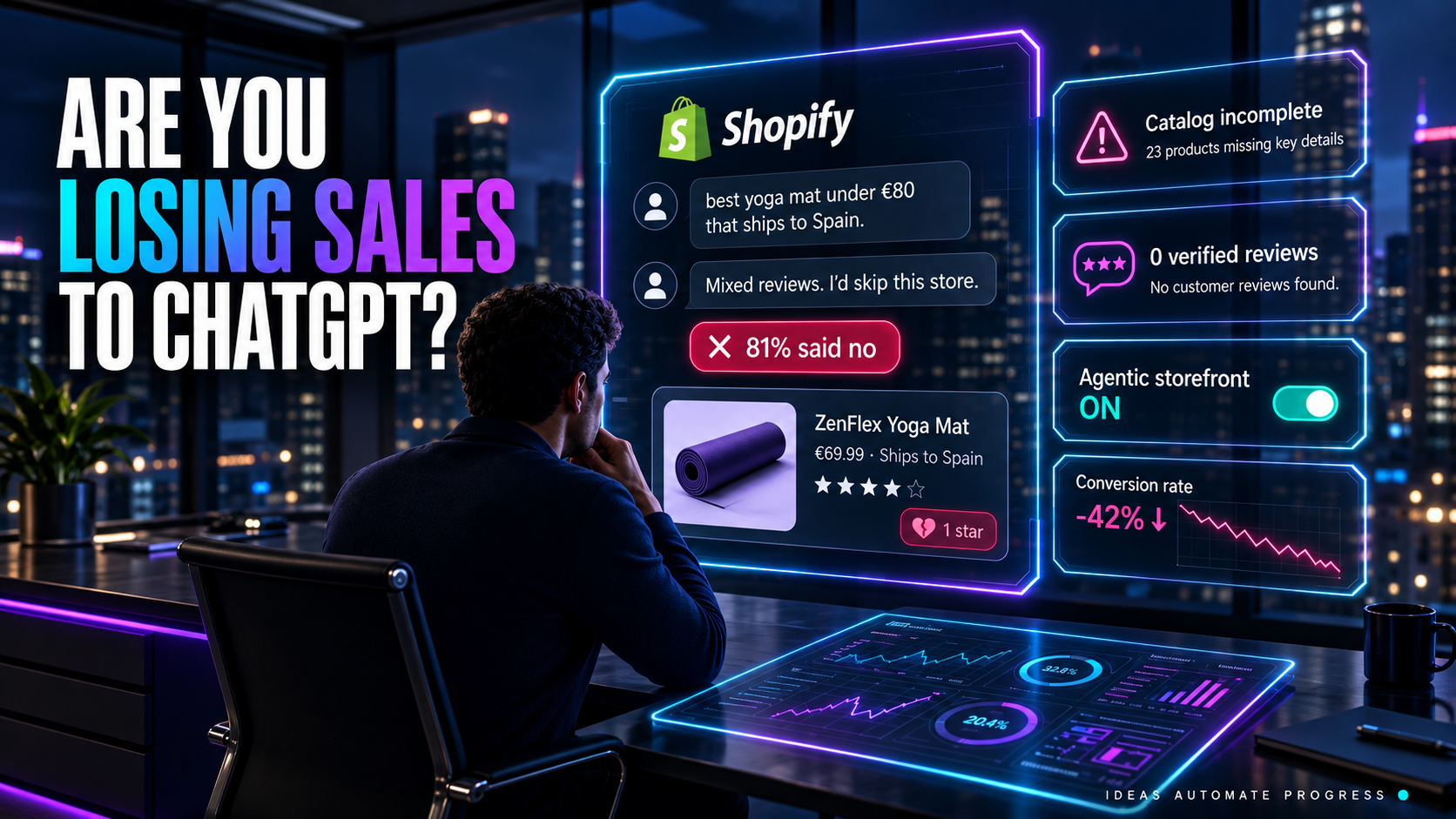
Someone was ready to buy. They had the tab open, or they were about to search your brand. First they asked ChatGPT a normal question: is this worth it, does it ship, what do people complain about, is Brand B better.
The assistant answered in twenty seconds. It cited a thin product page, an empty review widget, and a competitor with actual specs. The shopper closed the loop. Your Shopify analytics never saw them.
That is the new leak. Not a ranking drop. A conversation that happens before the session starts.
Founders miss it because the launch still looks fine. Theme is live. Ads can run. Checkout works. Meanwhile Shopify can already feed your catalog into ChatGPT, and shoppers treat the chatbot like a clerk who has read every review. If that clerk cannot defend the product, the store does not get a chance to.
The data caught up with the behavior last week. Semrush published the full numbers on 7 September 2026. Exploding Topics ran the survey in July with 2,338 US adults, about ±2 points on the full sample. MarTech put the sharpest cut on the front page on 18 September: among people who use chatbots while shopping online, nearly 81% have already been talked out of a purchase by the AI.
The precise cuts matter, because marketers keep quoting the wrong denominator.
- 80.93% of people who name AI chatbots as a source for online purchases have skipped a buy on AI advice. 42.81% have done it more than once.
- 57.5% of all AI users have been talked out of a purchase at least once.
- The same 57.5% figure appears on the other side: AI users who have bought something a chatbot recommended.
- Among power users (multiple times a week), 80.45% have bought an AI-recommended product. 54.95% have done it more than once.
- 85.31% of AI users would rethink a purchase if a chatbot flagged mixed or negative reviews. 74.15% of all consumers said the same.
- 59.27% of AI users have discovered a brand they did not know through a chatbot. 65.01% of AI users have at least partly replaced product-related Google searches with chatbots.
- Chatbot ads are slightly more likely to worsen brand opinion (23.12%) than improve it (20.36%). 71.63% of AI users feel neutral or negative toward those ads. 66% of people who dislike them say the ad made them doubt the integrity of the AI answer.
Read that as a two-way salesperson sitting between the shopper and your checkout. The model can introduce you. It can also close the file on you. Visibility without a defendable product record is not a win. It is a public rejection.
Semrush’s own conclusion is blunt: GEO is no longer optional, and brands that skip it are not only missing acquisitions. Chatbots are intercepting purchases that would have happened.
Why Shopify stores get hit first
If you sell on Shopify, this is not a future channel you can schedule for Q1. Shopify Agentic Storefronts can syndicate eligible catalogs into ChatGPT, Microsoft Copilot, Google AI Mode, and Gemini. For eligible stores the ChatGPT path is on by default. You do not install an app. You do not sign a deal with OpenAI. Shopify Catalog already holds title, price, availability, images, and policy fields, and ChatGPT can retrieve that record when a shopper asks a buying question.
Eligibility is narrower than the marketing copy. Shopify’s help docs currently require:
- the store sells to customers in the United States (the store itself can sit elsewhere)
- products qualify for Shopify Catalog
- Terms of service, Privacy policy, and Return and refund policy are filled in under Settings > Policies
- the merchant accepts the Agentic Storefronts supplemental terms
Checkout on ChatGPT is not Instant Checkout anymore. OpenAI pulled native in-chat checkout in March 2026. The shopper discovers in chat, then finishes on your store checkout through an in-app browser or a new tab. That sounds safer for brand control. It is not a shield. The decision to visit you at all now happens inside the assistant.
On 16 September 2026 OpenAI also wired ChatGPT Ads into Shopify as its first ecommerce partner. US merchants can create and manage campaigns from the Shopify app. International rollout starts 23 September in markets where ChatGPT Ads exist. So the same product record that an organic prompt uses is the record a paid Sponsored Agent will have to defend.
Two pipes, one truth layer. If the catalog is thin, both pipes leak.
Opting out is possible. In Admin go to Sales channels > Agentic and turn off “Allow Shopify to manage for me,” then disable ChatGPT catalog access. Shopify is honest about the limit: even after you opt out, ChatGPT can still mention you from crawled pages, reviews, Reddit, and YouTube. You can stop the official product card. You cannot stop the conversation.
How this ruins a store from day one
A typical new Shopify launch looks finished to the founder: theme, three lifestyle photos, AI-written descriptions, a 10% welcome code, a pixel, and zero review history. That is enough to look like a shop. It is not enough to survive an AI comparison.
1. Thin catalog data gets you listed, then rejected
Assistants retrieve from structured product data, policies, and public pages. A title like “Premium Yoga Mat – Best Quality” plus a 90-word brand poem gives the model nothing to defend.
When a shopper asks “which yoga mat does not slip on hardwood and ships to Spain in under a week,” the model needs thickness, material, weight, care, dimensions, origin, return window, and shipping reality. If a competitor filled those fields and you did not, you lose the shortlist even if your product is better in the real world.
Shopify has said AI searches against Catalog convert better than searches against scraped pages. That is only true when the Catalog record is complete. Garbage in still means a polished “I would start with Brand B.”
2. Empty or ugly reviews are a kill switch
This is the stat that should change launch sequencing. 85% of AI users rethink a buy when the bot flags mixed or negative reviews.
A brand-new store with 0 reviews looks unverified. A store with four five-star lines that all say “great product!!” looks worse: templated, unpaid, or both. Models also pull Trustpilot, Reddit, YouTube, Amazon, and forum threads. One unanswered “it ripped after two weeks” post will travel farther than your homepage hero.
Launching with a review app installed and no review operations plan is how a store dies in week two. The first 20 orders are not a vanity metric. They are the raw material the model will quote.
3. You cannot ad your way past a bad answer
The new Shopify ChatGPT Ads app is tempting because it lives next to the products you already manage. Semrush says chatbot ads are slightly more likely to hurt brand opinion than help it. People who dislike those ads mostly distrust the AI answer itself once they see a paid unit.
If you turn ads on before specs, shipping, and reviews are clean, you pay to open a labeled conversation that then repeats the hole in your catalog. Sponsored Agents make this worse, not better. The shopper can ask follow-ups. Follow-ups are where missing size charts, vague “contact us for shipping,” and unanswered complaints show up.
Paid inventory on a broken truth layer is not distribution. It is a paid focus group that talks people out of the cart.
4. Comparison prompts default to the incumbent
High-intent queries are not “buy yoga mat.” They are “is X worth it vs Y,” “does this actually work,” “cheapest reputable option that will not leak,” “safe for kids,” “returns if it fails.” Models answer those from reviews, spec sheets, and pages that already exist.
A new store with no comparison content, no sizing guide, and no “who this is not for” section gets summarized as unknown. Unknown loses. Incumbents win even when they are worse, because they are documentable.
5. Default syndication spreads the mess
Because Agentic Storefronts can syndicate without a custom integration, a sloppy launch does not stay private. Incomplete variants, missing GTIN, wrong inventory, placeholder policies, and “ships worldwide” with no transit times get copied into the surfaces shoppers now treat as research.
You do not get a grace period. The first 200 people who ask ChatGPT about your category can already receive a reason not to buy from you.
6. EU and non-US stores still get hit, just through the crawl
If you do not sell to the US, you may not get the official ChatGPT product card. You still get the research layer. ChatGPT, Gemini, Perplexity, and Copilot crawl your product pages, your policy pages, and third-party mentions. A Spanish or German Shopify store with thin descriptions and no comparison pages loses the same way. The feed is optional. The conversation is not.
What the model actually uses
Think in four layers. Most stores only build the first.
- Retrieval. Can the assistant find a current product record at all? Catalog fields, indexable product URLs, schema, and crawlable images.
- Understanding. Can it map the product to a natural-language job? “Waterproof hiking jacket under €150 that ships to Canada” needs attributes, not adjectives.
- Trust. Reviews, ratings from sources the model treats as verified, complaint patterns, brand reputation, policy clarity.
- Offer state. In stock, correct price, real shipping, return window that matches the claim on the page.
A pretty theme sits in none of those layers. AI product-description apps sit in layer 2 only if you feed them real specs. Most merchants feed them a title and hope.
The week-one audit
Do not start with ads. Start with the questions the model will be asked.
1. Prompt the category like a buyer.
Open ChatGPT, Gemini, and Perplexity in a private window. Ask the 10 questions a real buyer asks: best for [use case], worth the price, versus [the two brands it already names], shipping to [your real markets], return if it fails, common complaints, “who should skip this.” Screenshot every mention of you and every substitute. That list is the content backlog.
2. Open Sales channels > Agentic.
Confirm whether Shopify is managing channels for you. Note which surfaces are active. If policies are empty, fill Terms, Privacy, and Returns before you touch anything else. Incomplete policies can block official ChatGPT selling and also give the model nothing to say when a shopper asks “what if it breaks.”
3. Make Catalog boring and complete.
For each hero SKU: exact title, product type, vendor, variants that match physical reality, price, inventory, weight, materials, care, dimensions, origin, GTIN/barcode if you have it, shipping profile, return window in numbers, and images from multiple angles including scale. Kill “premium,” “luxury,” and “best” unless a measurable claim sits next to them.
4. Put proof on indexable pages.
If a spec lives only in a metafield, a PDF, or a packing insert, assume the model cannot defend it. One page per hero SKU should contain: who it is for, who it is not for, exact specs, what fails, how it compares to the two products ChatGPT already names, shipping and returns in plain numbers.
5. Treat reviews as operations, not a widget.
Reply in public to every negative review with a specific fix or refund path. Ask recent buyers for notes that mention use case, size, and durability. If you have no volume yet, do not fake stars. Get 15 to 20 real orders from people who will leave specific comments. Models weight specific, verified language over averages.
6. Only then test ChatGPT ads, with a hard cap.
If the store already sells and the audit looks clean, a small Shopify ChatGPT Ads test is rational. Cap spend. Read the actual conversations, not just ROAS. If the agent hedges, cites a bad review, or cannot answer shipping, pause and fix the source. Do not scale a conversation that ends in “maybe skip this one.”
7. Measure the new funnel separately.
In Shopify, split Agentic / AI-attributed orders from Google and Meta. Watch “mentioned but not chosen” in your prompt log. Rising mentions with flat AI-assisted conversion is the Semrush problem showing up in your store.
A 30-day sequence that does not waste money
Days 1-3. Policy pages, Agentic panel, prompt screenshots, list of kill questions.
Days 4-10. Catalog fields and comparison pages for the 5 to 10 SKUs that pay the rent. Ignore the long tail.
Days 11-20. Review collection on those SKUs. Public replies. Fix the one complaint pattern that keeps repeating.
Days 21-30. Recheck the same prompts. If the model can now state size, shipping, and “who this is not for” without hedging, run a small ChatGPT Ads test. If it still cannot, you do not have an ads problem. You have a product-information problem.
For a store that has not launched yet, delay paid AI inventory. Ship complete catalog fields, policies, and at least one comparison page first. “Launch fast” with empty proof is how the 81% statistic becomes your first-month story.
What not to do
- Do not bulk-generate 200 poetic descriptions and call it GEO.
- Do not buy fake reviews. Models and platforms are both worse at missing this than founders hope.
- Do not opt out of Agentic just to hide a messy catalog unless you also plan to fix the public pages. The crawl remains.
- Do not point a Sponsored Agent at a homepage. Point it at a product page that can answer objections.
- Do not treat Rufus, ChatGPT, and Perplexity as one channel. Amazon-heavy brands still need Rufus. Shopify DTC should fix ChatGPT and Google first. Perplexity cares more about citations.
The decision
For a live Shopify store with reviews and complete product data: treat this as an adopt-this-week audit, then a capped ad test.
For a store about to launch: complete the truth layer first. Theme polish is optional. Catalog fields, policies, comparison copy, and a plan for the first 20 reviews are not.
GEO on Shopify is not a blog post. It is product data, reviews, and the answer a model gives when someone asks whether they should buy from you at all.