Running an online store creates an incredible amount of data.
Google Analytics tells you where customers came from. Your ad platforms tell you how much you paid to get them there. Your ecommerce platform shows orders and conversion rates. Performance tools tell you when pages are slow. Session recordings show customers getting stuck. Error-monitoring tools find technical problems.
The problem is rarely a lack of information.
The problem is figuring out what actually deserves your attention today.
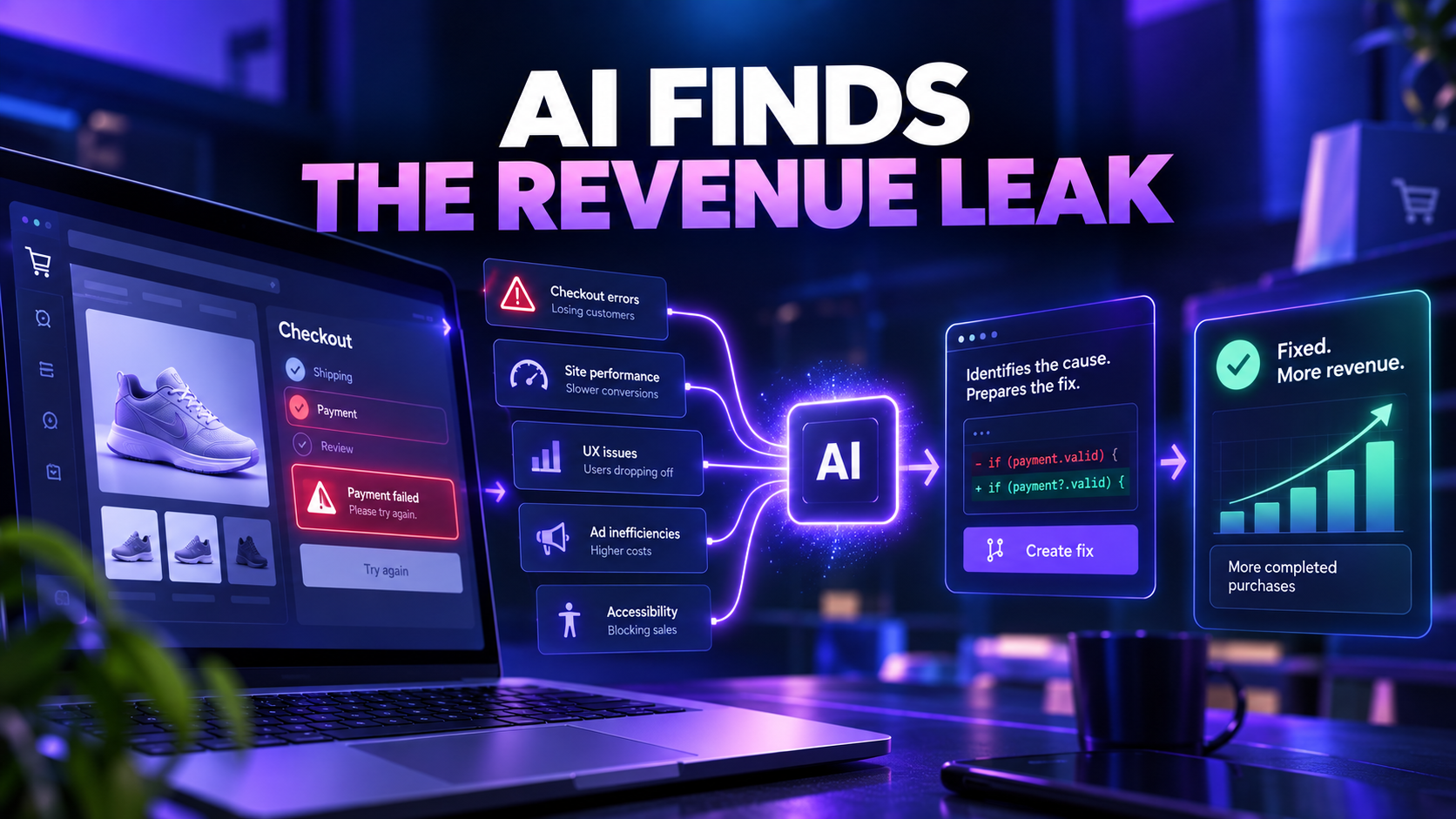
That’s what makes Noibu’s new AI agents interesting. Instead of adding another chatbot to an ecommerce dashboard, Noibu has launched six specialized agents designed to continuously look for problems and opportunities inside an online store.
And importantly, they don’t just tell you that something looks wrong.
They investigate what is happening, work out what could improve it and help prepare the change.
Noibu is basically building an AI ecommerce team
Noibu’s approach is surprisingly easy to understand.
Rather than creating one general AI assistant that tries to do everything, it has created six agents with specific jobs.
There’s a CRO Agent focused on improving conversion rates.
An A/B Testing Agent looks for ideas worth testing and helps prepare experiments.
A Bug Resolution Agent finds technical problems affecting customers and helps prepare fixes.
A Performance Agent watches things such as page speed and Core Web Vitals.
An Accessibility Agent looks for accessibility and compliance problems.
And a ROAS Agent focuses on whether your advertising is actually producing profitable results once customers reach your website.
Think of them less like six chatbots and more like six specialists watching different parts of the same store.
That’s particularly interesting for smaller ecommerce businesses because those are exactly the jobs they often don’t have dedicated people doing every day.
The agents don’t wait for you to ask a question
This is probably the biggest difference between Noibu’s approach and most AI tools.
Normally, you have to know that there’s a problem before AI can help.
You notice conversion has dropped. Then you open ChatGPT or another AI tool and ask:
“Why has my conversion rate dropped?”
But ChatGPT doesn’t automatically know what’s happening inside your store. You have to give it analytics, explain what changed and provide enough context for it to make a useful guess.
Noibu’s agents are already sitting on top of the ecommerce data.
They can continuously look at shopper behaviour, technical errors, conversion data and performance signals and identify something that deserves attention.
For example, imagine mobile conversion suddenly starts dropping.
The CRO Agent notices the change.
The Performance Agent sees that an important product page has become slower.
The Bug Resolution Agent detects a JavaScript error affecting some mobile users.
Instead of three separate dashboards showing three unrelated pieces of information, the system can start connecting them.
That’s where AI becomes much more useful.
Imagine the agents working on a real small online store
Take a relatively small ecommerce business spending €5,000 a month on Google and Meta Ads.
One campaign suddenly starts producing worse results.
Normally, the owner or marketing person opens the advertising dashboard and sees that ROAS has fallen.
The obvious conclusion is that the campaign isn’t working.
So they might change the creative, adjust the audience or reduce the budget.
But the campaign might not actually be the problem.
Perhaps a recent website update made the landing page significantly slower on mobile. Maybe the Add to Cart button occasionally fails. Or perhaps customers are reaching checkout and encountering a payment error.
Noibu’s ROAS Agent can look beyond the advertising numbers and connect campaign performance with what’s actually happening on the website.
At the same time, the Performance Agent and Bug Resolution Agent can investigate whether something technical is contributing to the problem.
Instead of simply saying:
“ROAS dropped 18%.”
the useful answer becomes something closer to:
“ROAS dropped, and customers coming from this campaign are experiencing a technical problem on the landing page. Here’s what appears to be causing it and here’s the proposed fix.”
For a small ecommerce team, that’s a much more valuable use of AI than generating another batch of Facebook ad headlines.
The CRO Agent is another good example
Conversion-rate optimization is one of those things almost every ecommerce business knows it should be doing more of.
In reality, it often gets pushed down the list.
Someone has to look through analytics, compare pages, watch customer sessions, identify where people abandon the journey and come up with an improvement worth testing.
Noibu’s CRO Agent is designed to continuously look for those opportunities.
Maybe customers frequently abandon a particular product page.
Maybe one category converts much worse on mobile than desktop.
Maybe visitors repeatedly interact with something that looks clickable but isn’t.
Maybe a checkout step creates unusual friction.
Instead of waiting for someone to eventually notice these patterns, the agent can actively look for them.
Then the A/B Testing Agent can help turn that observation into an experiment.
That’s where the six-agent approach starts making sense.
The agents aren’t necessarily six separate products. They’re specialists that can work on different parts of the same problem.
The Bug Resolution Agent could be particularly valuable for SMBs
Technical bugs are a perfect example of the problem smaller stores face.
A serious bug that completely breaks checkout gets noticed quickly.
The expensive bugs are often smaller.
Maybe 4% of customers using a particular browser can’t select a product variation.
Perhaps an error only happens when someone arrives from a specific landing page.
Maybe a third-party script occasionally prevents checkout from loading correctly.
Those problems can sit unnoticed for weeks because the website still appears to work normally for most people.
Noibu already focuses heavily on detecting ecommerce errors and connecting them to lost revenue.
Adding an AI agent changes what happens after detection.
Instead of simply creating another technical alert for somebody to investigate, the Bug Resolution Agent can analyze the issue and help prepare the fix.
The human still approves what goes live.
That’s important.
Noibu isn’t simply giving six AI agents unrestricted permission to rewrite a revenue-generating store whenever they feel like it.
The agents do the investigation and preparation, while people remain involved in approving changes.
That’s probably the right balance
Fully autonomous ecommerce makes for a better headline.
Human-supervised AI is probably more useful.
The time-consuming part of fixing a conversion problem isn’t usually clicking the final Publish button.
It’s finding the problem in the first place.
Then someone has to gather the data, reproduce it, understand what is causing it, decide whether it’s worth fixing and prepare the solution.
If an AI agent can do most of that work and present a human with:
Here’s the problem.
Here’s how much it appears to matter.
Here’s what caused it.
Here’s the change I’ve prepared.
Do you want to approve it?
that’s already extremely valuable.
Especially when the “team” running the online store might only be three or four people.
This is where AI agents start making sense for small businesses
AI agents are often demonstrated with complicated futuristic workflows.
Noibu’s approach is much easier to understand.
Give each agent a clear job.
Give it access to the information required to do that job.
Let it continuously look for useful work.
Then involve a human when something important needs to happen.
For a small ecommerce company, the result could feel like having a CRO specialist, performance analyst, QA engineer and advertising analyst constantly watching the store, even when nobody has time to open another dashboard.
That doesn’t mean those people suddenly become unnecessary.
It means a much smaller team can continuously investigate far more of the business than it could manually.
And that’s probably one of the strongest practical arguments for AI agents.
Small businesses don’t need more dashboards telling them they have problems.
They need help finding the problems that matter, understanding them and getting the work required to fix them ready.
That’s exactly what Noibu’s new AI agents are trying to do.
Source: Noibu, September 15, 2026