Small businesses don’t usually need another AI chatbot.
They need someone to follow up with leads, prepare proposals, check overdue invoices, summarize what happened last week, prepare a marketing campaign and remind them which three problems actually require their attention today.
Anthropic’s latest expansion of Claude for Small Business is interesting because it is increasingly designed around those jobs rather than around chatting with an AI.
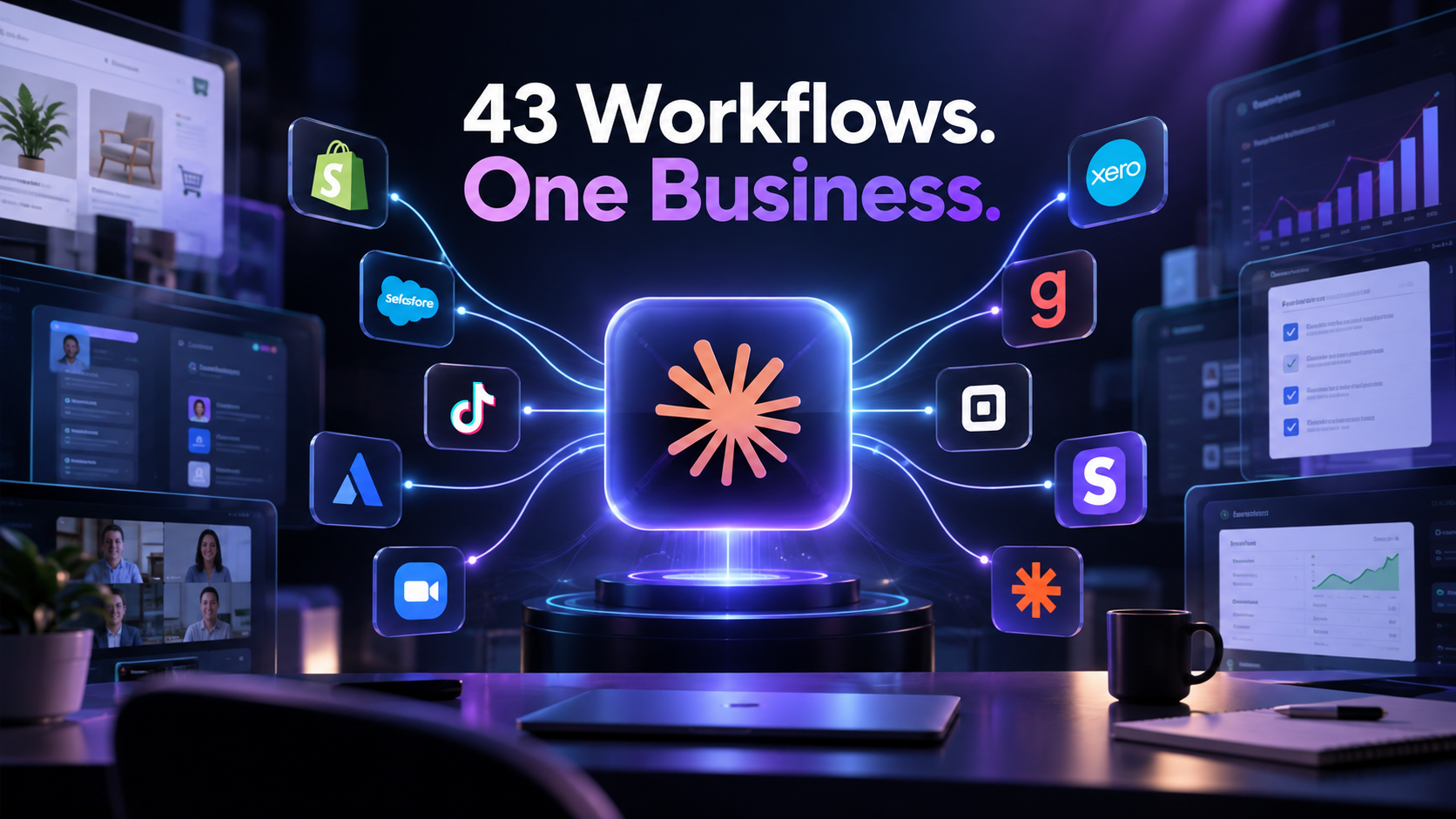
Claude for Small Business now offers 43 ready-to-run workflows and connections across 37 business software partners. The expanded ecosystem includes tools such as Shopify, Salesforce, HubSpot, Stripe, Square, Xero, Gusto, TikTok Ads, Canva, Zapier, Google Workspace and Microsoft 365.
The basic idea is straightforward. You enable Claude for Small Business inside Claude Cowork, connect the software your company already uses and choose a workflow. Claude can then work across those systems rather than requiring you to manually copy information into a chat window.
That sounds like a small difference. For an SMB, it can completely change what AI is useful for.
Consider a five-person service company that receives enquiries through its website. Normally somebody has to read the enquiry, decide whether it looks valuable, check the calendar, write a response and suggest meeting times.
Claude can qualify the lead, use the information already available in connected systems and prepare a response with actual calendar availability. The owner approves it and the reply goes out.
Or take a small agency preparing proposals. Claude can work from meeting notes, previous projects and pricing information to prepare a proposal based on similar work the company has done before. Anthropic highlights creative agency KANE as one example: it built a pipeline that scores leads from meeting notes, prices projects using previous work, prepares the proposal and gets the statement of work ready for signature.
The process that previously took weeks can happen within minutes.
Marketing is another obvious use case.
A small ecommerce company could connect Claude to Shopify, Canva and TikTok Ads, then use a workflow to prepare a campaign around a product launch. Claude can pull product information, help plan the campaign, prepare content and stage the work for approval.
The owner doesn’t need to understand APIs or build an automation in n8n first. The workflow already exists.
That is probably the most important part of this release.
AI automation has been available to technically capable businesses for years. You can connect an LLM to a CRM, accounting platform and marketing stack today using APIs, MCP, Zapier, Make or n8n.
Most small businesses don’t.
The limiting factor isn’t necessarily technology. It is setup.
A bakery owner, small retailer, consultant or ten-person agency usually doesn’t want to design an agent architecture. They want overdue invoices followed up.
Anthropic is essentially packaging those common business automations into an “agentic starter pack.”
One particularly useful workflow is the Monday business brief. Claude can assemble cash position, sales compared with the previous week, pipeline changes, overdue invoices and the three things requiring the owner’s attention. Instead of opening accounting software, CRM reports, spreadsheets and email every Monday morning, the owner gets one operational overview.
The same approach works for bookkeeping. Claude can help with month-end closing and reconciliation across connected financial systems. Anthropic says bookkeeping and HR provider HireEffect used Claude to identify 16 transactions responsible for a $13,000 discrepancy hidden among tens of thousands of PayPal transactions spanning two and a half years.
Another reporting workflow it built across five systems reportedly reduced a two-hour monthly task to around ten seconds.
These are not futuristic “AI employee” demonstrations. They are boring administrative jobs.
That is exactly why they matter.
Small companies often don’t have dedicated operations analysts, sales operations teams, marketing coordinators and finance departments. The owner and a handful of employees collectively perform all of those roles.
Saving three hours of someone’s time in a 500-person organization is useful. Saving three hours of the owner’s time every week in a five-person company can materially change how that company operates.
Anthropic has also been sensible about approvals. Workflows start in approval mode by default. Claude can prepare an email, campaign, payment or other action, but the owner approves it before anything sends, posts or pays. Businesses can later allow individual workflows to operate autonomously once they trust them.
Existing software permissions also carry through. If an employee cannot access something inside QuickBooks or Google Drive, connecting Claude does not automatically grant that access.
There are still gaps. Meta’s advertising platform, for example, isn’t currently among the official connectors. Businesses can potentially bridge unsupported services through Zapier or custom connectors, but the experience won’t yet cover every SMB stack perfectly.
Still, the direction is more important than any individual integration.
For years, AI adoption in small businesses largely meant opening ChatGPT or Claude and asking it to write something.
Then businesses started connecting AI to their data.
Now the next stage is emerging: AI connected to the software actually running the company, executing recognizable business processes on a schedule.
That makes Claude for Small Business considerably more interesting than another collection of prompts.
For an SMB owner, the question isn’t “What can Claude do?”
It’s much more practical:
Which recurring job do I never have enough time to do properly?
There is increasingly a good chance Claude can simply take the first pass at it.