If you run a small business in Spain, your customers probably don’t want to email you. They WhatsApp you.
They ask whether you have a table tonight. Whether the apartment is available next weekend. Whether you can fix their air conditioner tomorrow. Whether the product is in stock. Whether they can move their appointment. Whether you received the transfer. Whether their order is ready.
For many Spanish small businesses, WhatsApp isn’t another communication channel.
It is the customer interface.
The latest data from Spain’s CNMC makes that unusually clear. In its household panel covering the fourth quarter of 2025, 94.6% of Spanish internet users said they regularly use WhatsApp. Telegram was at 17.4%. WhatsApp also remained Spain’s leading service for internet calls and video calls, while 83.8% of smartphone users said they use messaging applications several times every day.
That context makes Meta’s new WhatsApp Business Tools MCP much more important than its rather technical name suggests.
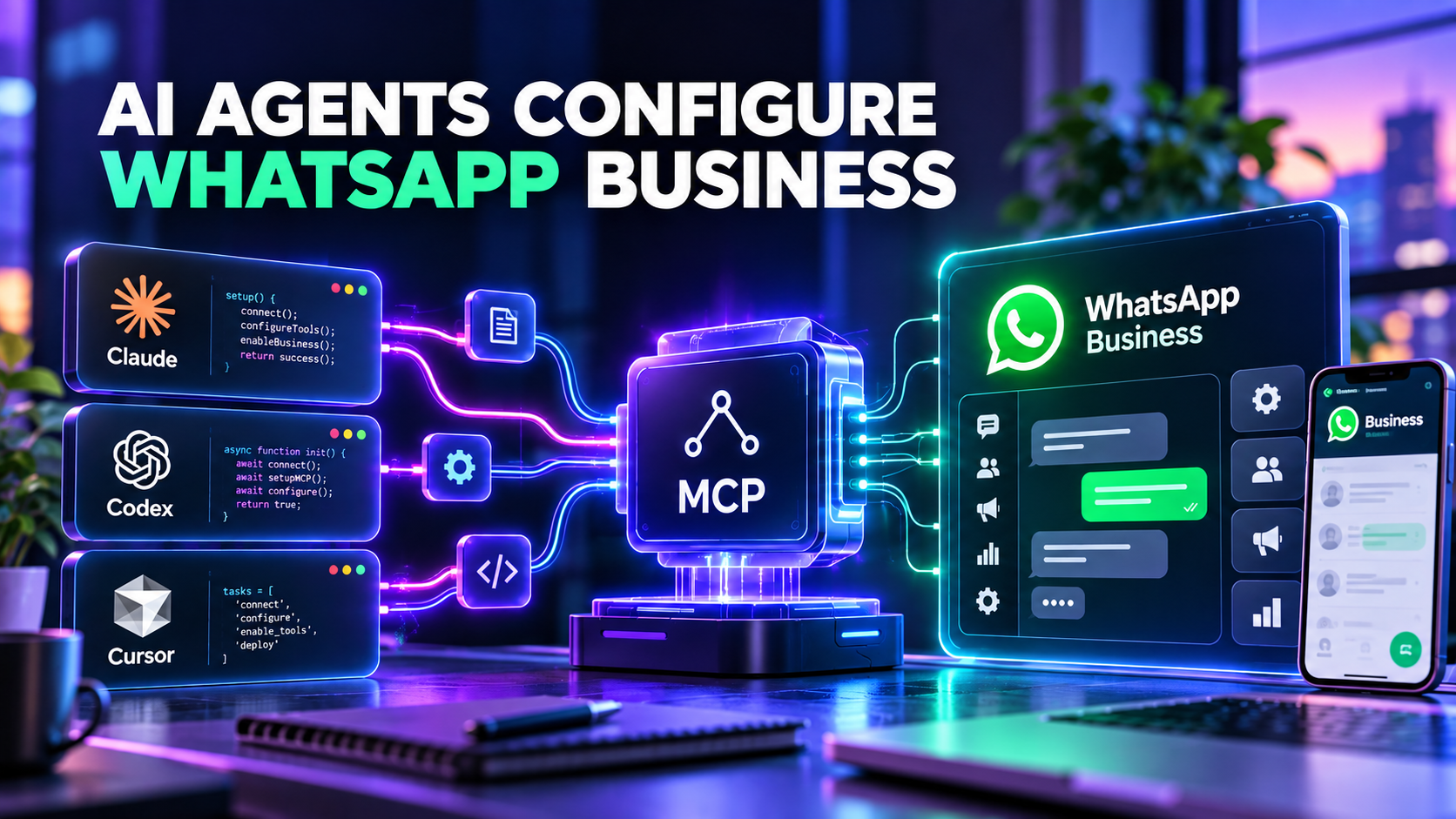
Meta has launched an MCP server that allows AI coding agents such as Claude, Cursor, Codex and ChatGPT to directly work with the WhatsApp Business Platform.
In practical terms, you can now ask an AI agent to help set up WhatsApp Business messaging instead of manually jumping between Meta’s Developer Console, Business Manager, API documentation and your code editor.
And anyone who has previously configured the WhatsApp Cloud API knows why that matters.
WhatsApp automation has always been more difficult than it should be
The business case for WhatsApp automation in Spain has been obvious for years.
The setup hasn’t.
Building a proper WhatsApp Business integration can involve creating and configuring a Meta app, setting up a WhatsApp Business Account, registering a phone number, verifying it, obtaining Cloud API access, configuring webhooks, creating message templates, understanding Meta’s messaging rules and troubleshooting several different dashboards when something silently fails.
For a developer, it is annoying.
For a small business owner, it is effectively inaccessible.
That creates a strange situation. The local restaurant, estate agent or dental clinic knows perfectly well that most customers contact them through WhatsApp, but building serious automation around that channel usually requires either technical expertise or an external provider.
The new MCP server attacks the setup problem directly.
You can tell an AI coding agent what you’re trying to accomplish and let it handle much of the technical work. Meta says agents can create the WhatsApp Business Account, add and verify phone numbers, register access to the Cloud API and check requirements such as Terms of Service acceptance.
The agent can also create and modify message templates, test messages and webhooks, and identify configuration problems involving payments or business verification.
Meta’s separate Social Technologies MCP can help the same agent search API documentation, discover endpoints and troubleshoot errors.
This doesn’t magically turn every Spanish autónomo into a software developer.
It does make the distance between “I want WhatsApp to do this” and a working integration considerably shorter.
Imagine a small holiday-rental business on the Costa del Sol
Suppose you manage twelve holiday apartments.
Every week you receive the same WhatsApp questions:
“Can we check in early?”
“Where do we collect the keys?”
“Is parking included?”
“What’s the Wi-Fi password?”
“Can we stay another night?”
“How do we get from Málaga airport?”
Today, someone probably answers those messages manually.
A proper WhatsApp integration could connect the conversation to the booking system. An AI assistant could identify the guest by phone number, retrieve the reservation and answer questions using information specific to that property.
The day before arrival, WhatsApp automatically sends check-in instructions.
On checkout morning, it sends the checkout procedure.
If the guest asks to extend their stay, the system checks availability and either provides the option or hands the conversation to a human.
The customer doesn’t install another app.
They don’t log into a portal.
They use WhatsApp.
Or take a dental clinic
A patient messages:
“Can I move my appointment from Thursday?”
Instead of a receptionist manually opening the calendar, finding the patient and typing available slots, an automated workflow could identify the appointment, check availability and reply:
“We can move you to Friday at 10:30 or Monday at 16:00. Which works better?”
The patient chooses Friday.
The system updates the calendar and sends confirmation.
Twenty-four hours before the appointment, WhatsApp sends the reminder automatically.
If the patient asks something clinical or unusual, the conversation transfers to a person.
The automation doesn’t replace the receptionist.
It removes the repetitive part of the receptionist’s job.
Restaurants are another obvious Spanish use case
Many independent restaurants already handle bookings informally through WhatsApp.
A customer sends:
“Hola, mesa para 6 mañana a las 21:00?”
A connected workflow could check the reservation system and respond immediately. If the requested time is unavailable, it could offer 20:30 or 21:30.
Once confirmed, the booking is written into the reservation system and the customer receives a reminder tomorrow.
After the visit, another message could politely ask for feedback or a Google review.
The owner hasn’t installed a new CRM.
The customer hasn’t learned a new booking interface.
The business has automated a conversation both sides were already having.
Local trades may benefit even more
Think about a plumber, electrician, air-conditioning installer or cleaning company.
A customer messages because their air conditioner isn’t working.
Instead of exchanging ten messages, the WhatsApp workflow asks for the postcode, model, description of the problem and a photo of the unit.
It can classify the job, check the service area and available appointment slots, then create the job inside the company’s scheduling system.
By the time a human looks at it, the enquiry is already structured:
Customer: María García
Location: Nerja
Issue: Daikin split unit not cooling
Photo: attached
Preferred time: Thursday morning
Likely job: diagnostic/service call
That is a very different workflow from somebody scrolling through 47 WhatsApp conversations at 8 PM trying to remember who needs calling tomorrow.
Lead qualification becomes particularly interesting
WhatsApp is also increasingly part of paid acquisition.
A Spanish SMB can run Meta advertising that sends potential customers directly into WhatsApp.
Imagine an estate agency advertising properties around Málaga.
A prospect clicks the ad and asks about an apartment.
The WhatsApp automation can ask:
Are you buying as a residence or investment?
What’s your budget?
Cash or mortgage?
Which areas are you considering?
When are you planning to buy?
Instead of every WhatsApp lead going directly to a salesperson, the system collects the basic information first.
High-intent leads can be routed immediately.
Lower-intent leads can receive relevant properties and follow-up automatically.
The CRM gets updated in the background.
Suddenly a Click-to-WhatsApp campaign isn’t merely generating conversations.
It is feeding a structured sales pipeline.
Ecommerce has similarly obvious applications
An online store could use WhatsApp for order updates, product questions and post-purchase support.
“Where is my order?”
The system checks the order and courier.
“Does this come in XL?”
It checks inventory.
“Can I change my delivery address?”
It verifies whether fulfillment has started and either updates the order or escalates the request.
Again, the important part isn’t that an AI can write a plausible answer.
ChatGPT could do that years ago.
The important part is that the assistant can connect the conversation to the systems where the actual answer lives.
This is where MCP matters
MCP, or Model Context Protocol, gives AI agents a standardized way to interact with external tools.
Meta’s new server essentially gives compatible coding agents a structured interface into WhatsApp Business configuration.
That means you can work conversationally with an agent while it performs technical setup against Meta’s actual platform.
Instead of:
read documentation → find API → copy credentials → configure webhook → test request → receive error → Google error → change configuration → test again,
the interaction starts looking more like:
“Set up WhatsApp Business messaging for this number, connect the webhook to this endpoint and create a template for appointment reminders.”
The agent can perform the steps, inspect what happened and troubleshoot failures.
For agencies and independent developers serving SMBs, that could substantially reduce implementation time.
A WhatsApp automation that previously wasn’t commercially worthwhile for a €500-a-month client may become viable if much of the repetitive setup and troubleshooting is delegated to a coding agent.
That could be especially relevant in Spain, where WhatsApp automation isn’t a niche feature.
You’re automating the communication infrastructure customers already use.
Meta is clearly heading further than setup
This release also fits into Meta’s broader Business Agent strategy.
Meta says more than one million businesses are already using a Meta Business Agent across WhatsApp and Messenger, and there are more than one billion active threads between people and businesses across WhatsApp, Messenger and Instagram every day.
Its Business Agent can already answer business-specific questions, recommend products, book appointments, qualify leads and hand conversations over to humans.
Meta is also building connections to external systems such as Shopify and Zendesk so agents can take actions rather than simply answer questions.
The WhatsApp Business Tools MCP tackles another part of the problem: making the underlying infrastructure easier to deploy and maintain.
Put those trends together and the direction becomes fairly obvious.
WhatsApp is becoming programmable through AI.
But don’t automate the humanity out of WhatsApp
There is a risk here.
WhatsApp works particularly well for small businesses precisely because it feels direct.
Customers believe they’re talking to the restaurant, their estate agent, the person managing their apartment or the mechanic fixing their car.
Replacing every interaction with a robotic chatbot would destroy part of that advantage.
The better model is automation around the conversation.
Let AI answer repetitive questions.
Let it collect information.
Let it check availability.
Let it send reminders.
Let it retrieve order status.
Let it prepare the conversation for the employee.
And make handing over to a human extremely easy.
For many SMBs, the goal shouldn’t be “nobody ever has to speak to customers again.”
It should be:
Nobody on the team should have to type the same answer 30 times every week.
This could matter disproportionately in Spain
Software trends often arrive from the United States with assumptions about how customers communicate.
Spain is different.
Email is important. Websites matter. Phone calls still happen.
But WhatsApp sits unusually close to the center of everyday communication.
When 94.6% of internet users regularly use the same messaging platform, businesses don’t need to convince customers to adopt a new interface.
The interface is already installed on almost everyone’s phone.
That gives Spanish SMBs a potentially powerful opportunity.
The next generation of business automation doesn’t necessarily need another customer portal, mobile app or complicated chatbot widget.
For a restaurant, clinic, estate agent, rental manager, retailer or tradesperson, it could simply appear inside the WhatsApp conversation customers are already starting every day.
And Meta just made building that considerably easier.
Excerpt: Meta’s new WhatsApp Business Tools MCP lets Claude, Codex, Cursor and ChatGPT configure WhatsApp Business integrations conversationally. In Spain, where 94.6% of internet users regularly use WhatsApp, that could make practical SMB automation dramatically easier.
Sources: Meta/WhatsApp Business Tools MCP announcement, September 15, 2026; TechCrunch, September 15, 2026; CNMC Panel de Hogares, May 2026.