Every new advertising platform creates extra work for a small marketing team. Campaigns need to be created, products synchronized, tracking configured, leads connected to the CRM and results compared with the channels the business already uses.
OpenAI’s first major ChatGPT Ads integrations are designed to reduce that workload.
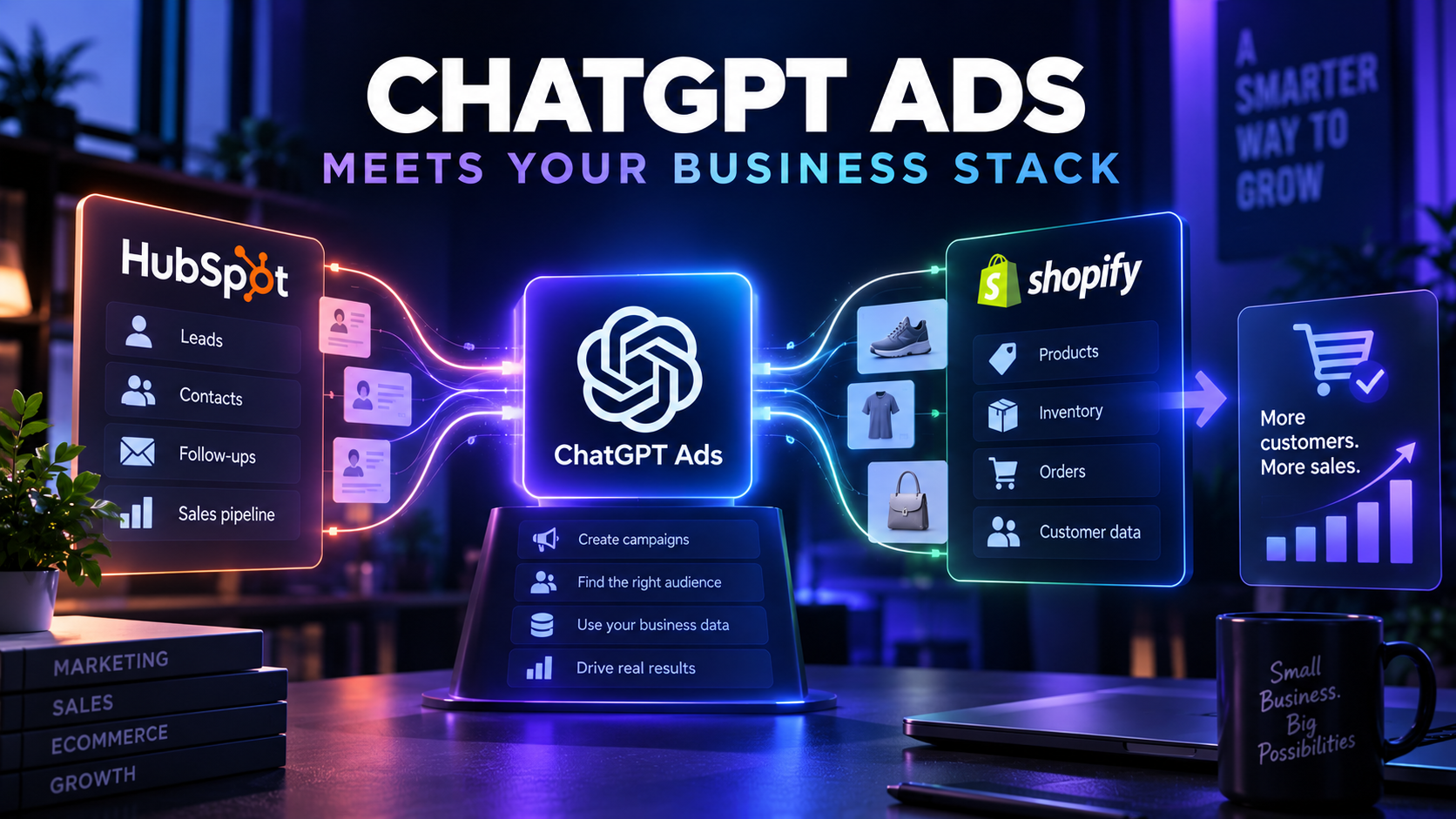
HubSpot is becoming ChatGPT Ads’ first CRM partner, while Shopify is its first ecommerce partner. Together, they connect OpenAI’s advertising platform directly to two systems already used by huge numbers of small and medium businesses.
For SMBs, that makes ChatGPT Ads much easier to treat as another measurable acquisition channel rather than a completely separate marketing project.
HubSpot brings ChatGPT Ads into the existing sales process
Businesses using HubSpot can connect their ChatGPT Ads account and work with campaigns alongside their existing marketing and sales activity.
Campaigns can be created with targeting, budgets and schedules, while performance data flows back into HubSpot.
The most useful part is what happens when the advertising generates a lead.
That person can enter the same CRM the company already uses and move into its existing follow-up process.
The workflow becomes relatively simple:
ChatGPT Ad → HubSpot contact → automated follow-up → sales pipeline → customer
That matters because generating a lead is only useful when the business can do something with it.
A small sales team might already have HubSpot workflows that assign leads, send follow-up emails, create tasks and notify salespeople. ChatGPT Ads can become another source feeding that system.
The business doesn’t need to invent a completely separate sales process for AI-generated leads.
HubSpot also makes attribution much more useful
One of the first questions any SMB should have about a new advertising platform is straightforward:
Did it generate customers?
HubSpot can connect advertising activity to contacts and deals, allowing ChatGPT Ads to be measured alongside other acquisition channels.
That becomes particularly important because ChatGPT is a different advertising environment from Google or Meta.
Clicks will matter, but the more interesting question is what happens afterwards.
If a company spends €1,000 on ChatGPT Ads, HubSpot can help connect that spend to the contacts, opportunities and customers that entered the CRM.
That gives smaller businesses a familiar way to evaluate the new channel.
They can compare it with Google Ads, Meta campaigns and other lead sources using the customer data they already rely on.
Shopify solves the product side of the problem
The Shopify integration handles a different part of the advertising workflow.
US merchants can install the ChatGPT Ads app and connect their store directly to OpenAI’s advertising platform.
The integration synchronizes the merchant’s product catalogue and inventory information with ChatGPT Ads. Store changes can therefore keep the advertising system updated without the merchant manually maintaining another product feed.
The OpenAI Pixel for Shopify also sends eligible commerce events back to Ads Manager for measurement and optimization.
For a smaller ecommerce company, that significantly lowers the technical barrier to experimenting with the platform.
A merchant can create campaigns around the whole store, specific products or the website while keeping product information connected to Shopify.
That matters because ecommerce businesses already spend a lot of time keeping Google, Meta and other channels synchronized with their catalogue.
A new advertising platform becomes much more attractive when connecting it is closer to installing an app than starting an integration project.
Conversational ads make accurate product data even more valuable
OpenAI is launching these integrations alongside its new Sponsored Agents advertising format.
Sponsored Agents allow users to start a conversation with an advertiser’s AI directly inside ChatGPT.
That creates an interesting role for the Shopify catalogue.
A customer may see a product and immediately ask questions about it. The more accurate and current the underlying product information is, the more useful that conversation can become.
Inventory, specifications, pricing and product details can all contribute to the advertising experience.
For ecommerce businesses, the product feed therefore becomes more than a way of telling an advertising system which products should appear.
It can help provide the information AI needs while someone is deciding what to buy.
HubSpot brings customer context and Shopify brings product context
The choice of these first two partners makes sense.
HubSpot contains information about leads, deals, sales activity and customer relationships.
Shopify contains products, inventory, orders and ecommerce events.
Together they represent two important sides of the advertising process.
One helps businesses understand who responded to the advertising and what happened afterwards. The other helps OpenAI understand what the business actually sells.
For SMBs, these connections can remove a lot of the operational friction that normally comes with adding a new marketing channel.
That’s important because small marketing teams already have plenty of software.
A company may be running Google Ads, Meta, email marketing, SEO, social media and content with only one or two people.
Adding ChatGPT Ads becomes far more realistic when the new channel connects to the systems already running the business.
ChatGPT Ads is starting to look like a real SMB advertising platform
Advertising platforms become useful to small businesses when they are easy enough to operate and measurable enough to justify the spend.
OpenAI is gradually putting those pieces together.
The advertising itself can become conversational through Sponsored Agents.
AI can help create and manage campaigns.
HubSpot can connect the advertising to leads and sales.
Shopify can provide the product catalogue and ecommerce events.
The result is beginning to look like an advertising ecosystem rather than a few sponsored messages appearing inside ChatGPT.
There are still major questions around pricing, targeting, attribution and how customers will respond to ads inside an AI assistant. Those answers will become clearer as the platform expands.
From an SMB perspective, though, the HubSpot and Shopify integrations solve a much more immediate problem: making the channel practical to operate.
The easier ChatGPT Ads becomes to connect to the systems a business already uses, the easier it becomes for a small company to actually experiment with it.
That’s an important step if OpenAI wants ChatGPT Ads to compete for the same SMB marketing budgets currently going to Google and Meta.