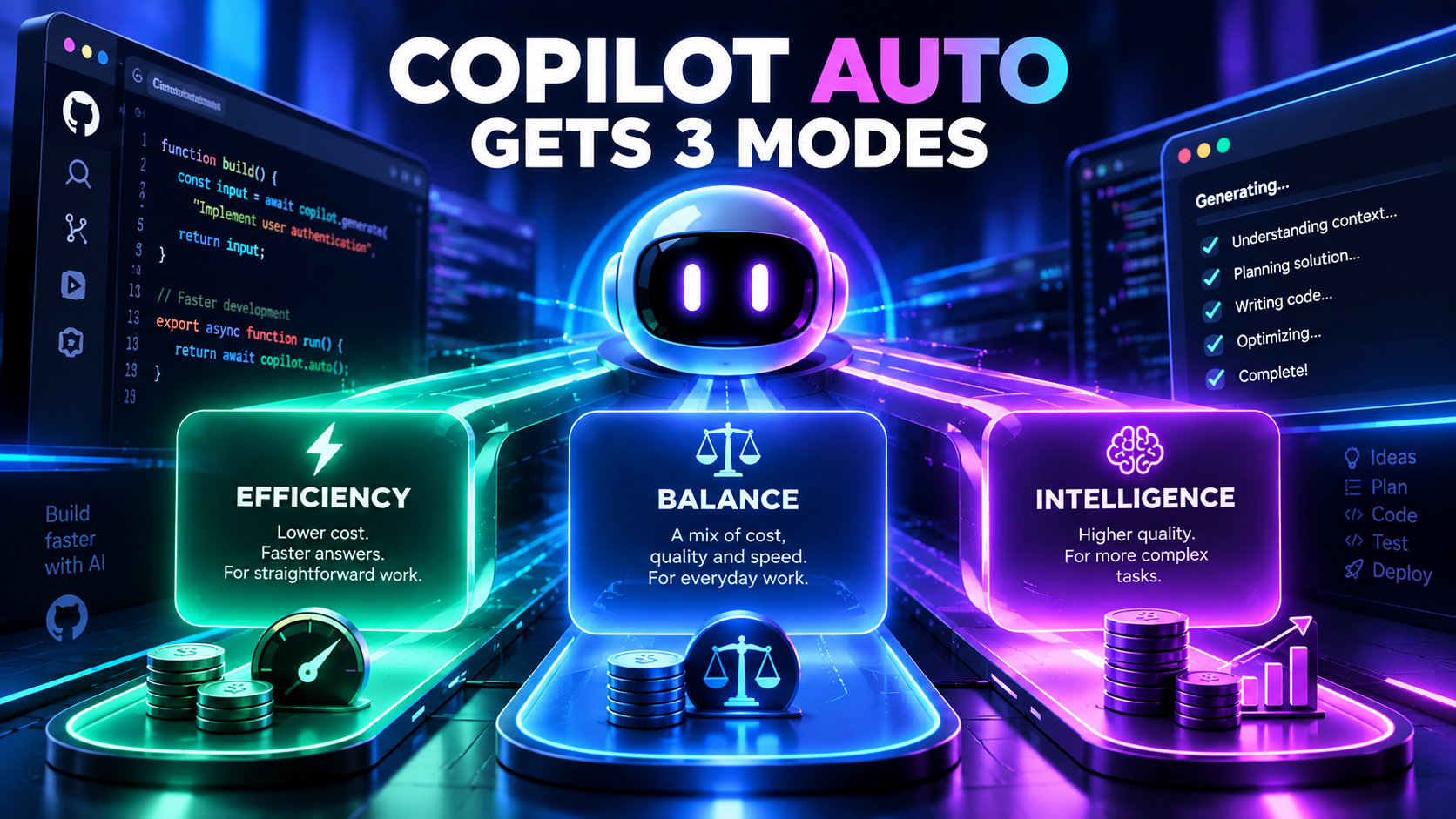
GitHub shipped a small changelog item on 14 September 2026 that will matter more to small product teams than another model name. Copilot Auto model selection now has three tiers: Efficiency, Balance and Intelligence. Auto still chooses a model for each prompt. The tier only changes how Auto weighs cost, quality and waiting time when it chooses.
Efficiency leans toward cheaper, faster answers and is aimed at straightforward work. Balance tries to hold cost, quality and latency in the same hand, which GitHub calls a fit for everyday work. Intelligence leans toward quality and is aimed at harder tasks. All three tiers draw from the same list of models. Auto still looks at the prompt itself. GitHub’s own example is a docstring on an existing function: even on Intelligence, Auto may send that job to a small model because the task does not need a heavy one.
The feature is rolling out in Visual Studio Code, Copilot CLI and the GitHub Copilot app. Billing has not become a flat fee. Usage is charged for the model Auto actually selected, whatever tier you set. Paid subscribers still get the existing 10 percent discount on usage billed through Auto. GitHub describes the change as a first step toward letting people see the tradeoff they are making, rather than treating Auto as a black box that either feels cheap or feels good.
That is a quieter kind of product news than a new flagship model, and it is closer to how small teams actually burn money in 2026.
Agent mode turned Copilot from a keystroke saver into a usage line
For a long time Copilot was easy to budget. Completions happened in the editor. The bill was a seat. Then agent mode, CLI agents and long sessions arrived. A developer could ask Copilot to explore a repo, patch a failing test, write a migration and open a pull request. Each of those steps eats tokens. A solo founder shipping a client app, or a three-person shop maintaining five WordPress and Next.js properties, suddenly had a second bill that moved with how ambitious the prompt was.
Auto was supposed to be the grown-up answer: stop picking models by hand, let the system choose. In practice Auto without a bias is a personality. Some days it feels generous and the invoice looks like a weekend of agent work. Some days it feels stingy and the agent stalls on a gnarly type error. Small teams do not have a FinOps person to read token reports. They have a founder who notices Stripe and GitHub in the same week and wonders which tab is lying.
The new tiers do not remove that tension. They name it. Efficiency, Balance and Intelligence are an admission that “the right model” is not a technical fact. It is a business preference. A studio that lives on tight retainers does not want the same default as a product company debugging a multi-service outage.
The interesting detail is that the tiers share a model list
If Intelligence simply unlocked a secret larger model, this would be a pricing page with extra buttons. GitHub is saying something different. The pool is the same. Auto still judges the prompt. Intelligence changes the weights, not the catalogue. That means a cheap task can stay cheap even when the workspace is set to think hard, and a hard task can still get an expensive model when the workspace is set to save money, if Auto decides the cheap option will fail.
Whether that works depends on Auto’s taste. Changelog copy is confident. Real repos are full of prompts that look simple and are not: “fix the flaky test,” “make this form match the design system,” “refactor this module but do not break the webhook.” Those sentences do not advertise their difficulty. If Auto under-ranks them on Efficiency, the team pays later in review time. If Auto over-ranks them on Intelligence, the team pays immediately in tokens.
For an SMB that writes software as a product or as a service, that judgement call is now part of the stack. It sits next to which CI minutes you buy and whether you self-host runners. It is not as visible as those things, because the cost arrives after the session, attached to a model name most clients will never see.
This is cost control for people who already live in the editor
There is a whole market of “AI coding agents for business” that assumes the buyer wants a new workspace. Copilot’s change assumes the opposite. The workspace is already VS Code or the Copilot app. The missing piece was a way to tell Auto what kind of month this is.
That fits how small technical teams work. They do not switch tools when a bill spikes. They change a setting, complain in Slack, and keep shipping. A three-way bias is crude, but crude is usable. Efficiency for boilerplate and UI copy. Intelligence for the incident. Balance for the eight hours in between. The 10 percent Auto discount still sits on top, which is GitHub quietly arguing that staying inside Auto is cheaper than hand-picking the expensive model “just in case.”
It also exposes a limit. The tier does not cap spend. It does not show, prompt by prompt, why Auto picked what it picked. GitHub says more visibility is the direction of travel. Until that visibility arrives, a small team can change the vibe of Auto without being able to audit it. That is better than a single opaque default. It is not the same as knowing what Friday’s agent session cost before Monday’s invoice.
Why this belongs in an SMB feed at all
Most Copilot changelog items are enterprise admin controls or metric fields for people who manage hundreds of seats. This one is closer to the ground. Agencies that build and maintain product for clients have already felt agent usage as a project cost. Founders who code their own SaaS have felt it as a personal cost. Both groups have been doing a clumsy version of these tiers by switching models manually, or by avoiding agent mode when the month looks expensive.
GitHub is now encoding that behaviour in the product. The opinion baked into the release is that model choice is no longer a developer preference you set once. It is an operating choice you might want to change when the work changes. For a small team, that is the whole story: the editor finally admits that intelligence has a price, and that not every line of code is worth paying it.