Most small businesses still have one piece of technology that works almost exactly the way it did twenty years ago.
The phone.
A customer calls. Someone has to stop what they’re doing and answer it. If nobody answers, the customer leaves a voicemail, tries again later or simply calls someone else.
For restaurants, tradespeople, clinics, property businesses, garages, salons, hotels and hundreds of other small businesses, that phone call is often much closer to revenue than a website visit.
OpenAI’s new GPT-Live-1 API makes that part of the AI story considerably more interesting.
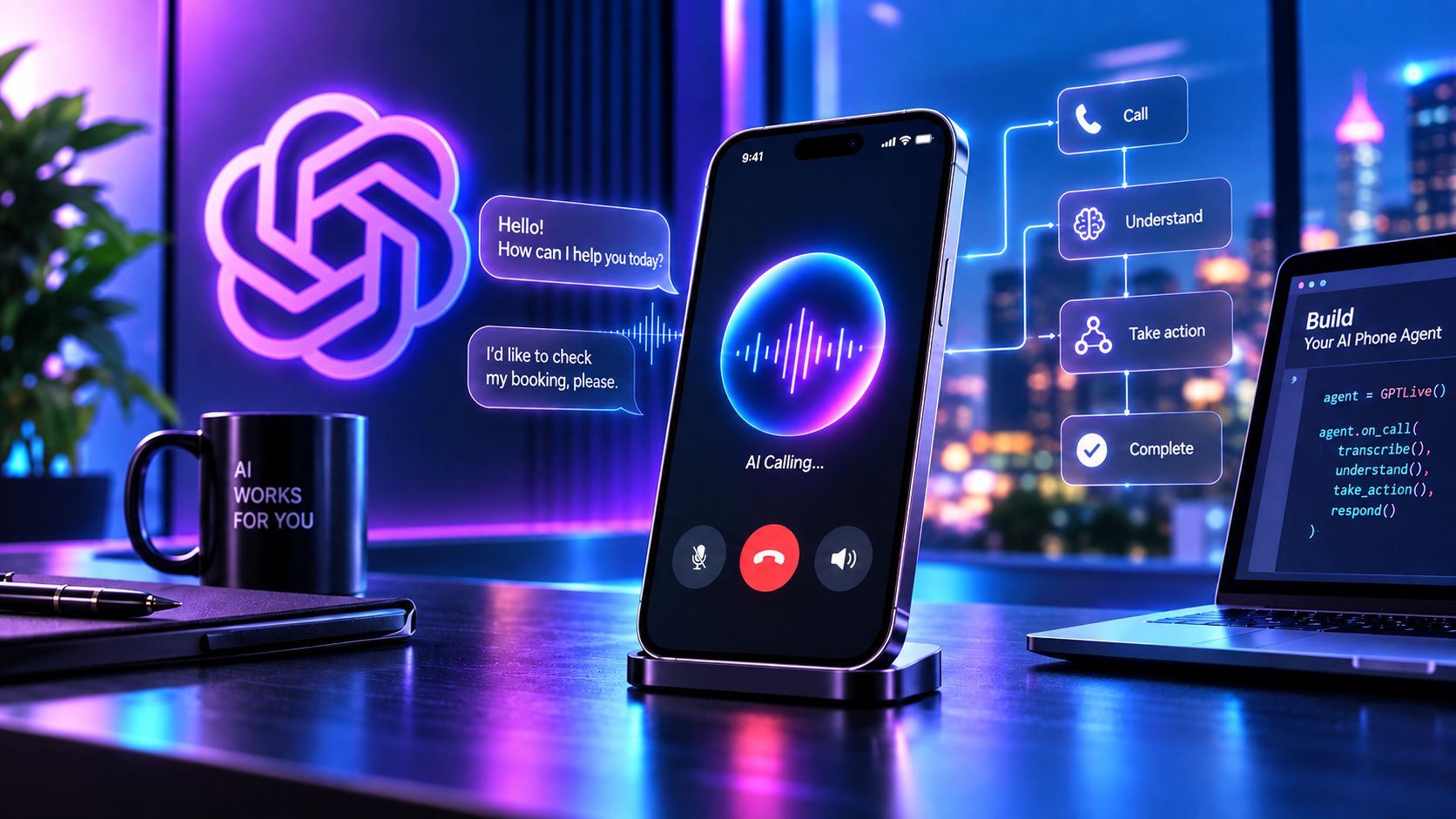
GPT-Live-1 is a real-time voice model designed specifically for natural conversations. It can listen and speak at the same time, deal with interruptions and acknowledgements as they happen and hand more complicated work to other AI models and tools behind the conversation.
It costs $0.05 per minute for the voice layer, with the backend AI and tools charged separately.
The technology itself is impressive.
But the interesting part for small businesses isn’t having another AI you can talk to.
It’s having an AI that can answer the phone and actually do something.
Voice AI has had a usability problem
Automated phone systems aren’t new.
We’ve all experienced them.
“Press one for sales.”
“Press two for support.”
“Please say your account number.”
“No. Sorry. I didn’t understand that.”
Traditional phone automation works reasonably well when customers follow a carefully designed decision tree. It falls apart as soon as humans behave like humans.
Real conversations aren’t turn-based.
People interrupt. They pause halfway through a sentence. They say “actually, never mind” and change what they want. They start answering before the other person finishes speaking.
That timing is one of the reasons older voice bots feel so obviously artificial.
GPT-Live-1 is designed differently. Because it is full-duplex, it can listen while speaking and react to interruptions in real time.
That sounds like a technical detail, but it’s fundamental to making an AI phone conversation feel less like navigating an automated menu.
OpenAI says language-learning company Speak saw interruptions during thinking pauses fall by almost 80% compared with previous turn-based systems in early evaluations.
Yelp is already using GPT-Live-1 for calls involving things like restaurant reservations and food orders and says it has seen improvements in call-handling rates.
These aren’t futuristic demonstrations anymore.
They’re actual phone calls.
The real breakthrough is what happens behind the voice
A natural-sounding AI receptionist is useful.
A natural-sounding AI receptionist connected to business systems is much more interesting.
Imagine someone calls a garage:
“Hi, I’ve got a 2021 Golf and the check-engine light came on yesterday. Can you take a look this week?”
The useful AI doesn’t simply answer politely.
It understands the request, asks for the missing information, checks the garage’s booking system, finds an available slot, creates the appointment and sends the customer confirmation.
A property business could answer questions about a listing and schedule a viewing.
A dental clinic could move an appointment.
A restaurant could answer a question about allergens and take a reservation.
A plumber could qualify whether a job is urgent, collect the address and create a callout.
A service company could answer “Where’s my order?” by looking up the customer’s actual order rather than reading a generic FAQ.
The conversation is only the interface.
The real value comes from connecting that conversation to calendars, CRMs, booking systems, order databases, email, payments and automation tools.
That’s why the architecture behind GPT-Live-1 is interesting.
The voice model doesn’t have to do everything itself. It can handle the fast, natural conversation while delegating deeper reasoning or actions to another model and the tools connected behind it.
In other words, the person on the phone doesn’t need to sit through awkward silence while one enormous AI model thinks about everything.
The conversation and the work can happen together.
The economics are becoming interesting too
At $0.05 per minute, a five-minute GPT-Live-1 conversation costs about $0.25 for the voice layer before the backend model, telephony and any other infrastructure.
That isn’t free.
But compare it with the business value of the call rather than the cost of sending a chatbot message.
If a €100 service appointment would otherwise have gone unanswered because everyone was busy, the economics look very different.
This is particularly important for small companies because they rarely have call centres.
The person answering the phone might also be the owner, receptionist, salesperson, mechanic or technician.
Every interruption has a cost.
And every unanswered call potentially does too.
The phone might become one of AI’s most practical interfaces
AI development has been heavily focused on chat windows because typing is convenient for software developers.
Businesses don’t necessarily work that way.
Customers already know how to use the telephone. They don’t need an app, an account or instructions explaining how to talk to an AI agent.
They simply call the same number they’ve always called.
That’s what makes this category so interesting.
The customer experience doesn’t need to change very much at all.
The infrastructure behind it does.
We are probably still some distance from people happily having complicated, sensitive conversations with autonomous phone agents. There are also obvious questions around disclosure, reliability, accents, privacy and what happens when the AI gets something wrong.
But the basic technology is crossing an important threshold.
An AI phone system no longer has to sound like an automated phone system.
And once the voice becomes natural enough, the interesting question stops being whether AI can answer the phone.
It’s what the AI can do once it has answered.
For millions of small businesses, that may turn out to be one of the most practical uses of AI we’ve seen yet.