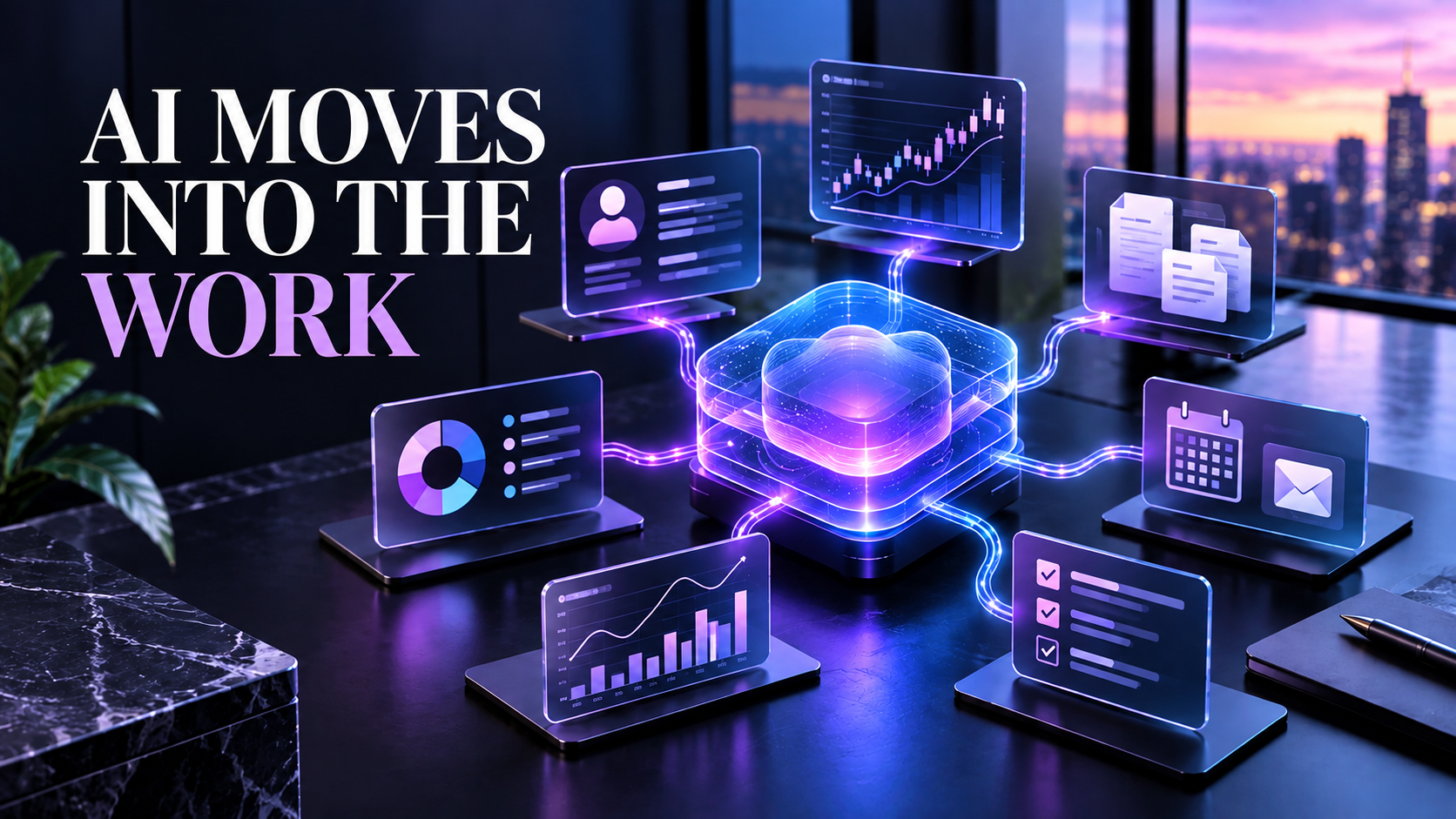
Claude for Financial Advisors connects Claude with investment and wealth-management platforms from companies including BlackRock, Charles Schwab and Addepar. instead of sitting in a separate browser tab.
You open ChatGPT or Claude, explain what you’re working on, upload a document, copy some information from another system, ask a question and then copy the answer back into whatever software you were actually using.
It can be incredibly useful, but it’s also a fairly clumsy way to work.
Anthropic’s new Claude for Financial Advisors gives us a much better picture of what the next stage of business AI might look like. And although the product is aimed at financial advisers rather than small businesses, the underlying idea is far more interesting than the financial industry itself.
Claude is being connected directly to the systems where the work already happens.
The interesting part isn’t financial advice
The idea is relatively straightforward. Instead of a financial adviser manually gathering information from several systems before meeting a client, Claude can pull together the relevant portfolio information, CRM records, research and other data required to prepare for that meeting.
It can then help with portfolio reviews and follow-up work afterwards.
The important distinction is that Claude isn’t simply being given a clever financial prompt.
It has access to the actual systems involved in doing the job.
That changes the experience completely.
Imagine asking an AI:
“Prepare me for my meeting with this client.”
A generic chatbot needs you to explain who the client is, upload their documents and provide whatever context it needs.
An AI connected to the company’s systems can potentially understand who the client is, retrieve the relevant CRM history, find recent interactions, pull the required financial information and prepare the briefing.
The prompt becomes dramatically simpler because the AI already has the context.
This is much more relevant to small businesses than it looks
Most SMBs obviously don’t use BlackRock portfolio systems.
But they do use software.
They have customer information in HubSpot or another CRM. Their invoices might live in QuickBooks or another accounting platform. Documents are sitting in Google Drive or Microsoft 365. Contracts are in DocuSign. Customer conversations are scattered across Gmail, WhatsApp and support systems.
The owner often becomes the integration layer between all of them.
Someone asks a question and the owner knows that the answer requires checking an email, looking at the CRM, finding an invoice and perhaps opening a spreadsheet.
That’s one reason AI hasn’t yet transformed many small businesses as dramatically as the demos suggest it should.
The AI might be intelligent enough to solve the problem, but it doesn’t have the context required to do it.
Connecting AI to business systems changes that.
Anthropic itself has already been moving in this direction beyond finance. Claude for Small Business connects with tools including QuickBooks, PayPal, HubSpot, Canva, DocuSign, Google Workspace and Microsoft 365. The financial adviser product simply makes the direction particularly obvious.
The future business assistant probably isn’t something you constantly feed information.
It already knows where it’s allowed to look.
The connector might become more important than the model
This also changes what matters when choosing AI software.
We’ve spent an enormous amount of time comparing models.
Is Claude better than ChatGPT? Is Gemini better at this particular task? Which model scores highest on a benchmark?
Those differences still matter, but for many everyday business jobs they may matter less than something much more boring:
Can the AI access the information required to complete the job?
The world’s smartest model isn’t particularly useful when the customer history it needs is locked inside a CRM it can’t access.
A slightly less capable model connected securely to the CRM, accounting system, email, calendar and document storage might be dramatically more useful.
That’s why connectors, MCP servers, permissions and integrations are becoming such an important part of the AI ecosystem.
The model provides intelligence. The integrations provide context.
You need both.
This could change how business software is sold
There’s another consequence here.
Traditional SaaS software has always competed heavily on its interface.
Companies spend huge amounts of money designing dashboards, menus, filters and workflows because humans have to navigate the software themselves.
AI agents introduce another interface.
Instead of opening five applications, finding the correct information and assembling it yourself, you might simply ask:
“What’s happening with the Martínez account?”
The AI could retrieve the latest emails, outstanding invoices, CRM notes, upcoming meetings and project status, then explain the situation.
The underlying software hasn’t disappeared. In fact, it becomes even more important because that’s where the trusted business data lives.
But the way humans interact with it changes.
We may eventually spend less time operating business software and more time asking AI to operate across it.
The real AI race is moving beyond the chatbot
That’s why Claude for Financial Advisors is more interesting than another industry-specific AI product.
It shows where business AI is going.
Models are becoming the reasoning layer sitting above existing software, data and workflows.
The companies that make this work won’t necessarily win because they have the smartest chatbot. They’ll win because their AI can understand the business, access the right systems, respect permissions and actually complete useful work across them.
For a small company, that could eventually mean something much more valuable than having an AI assistant.
It could mean having an AI that actually understands how the business operates.
And that’s a very different product.