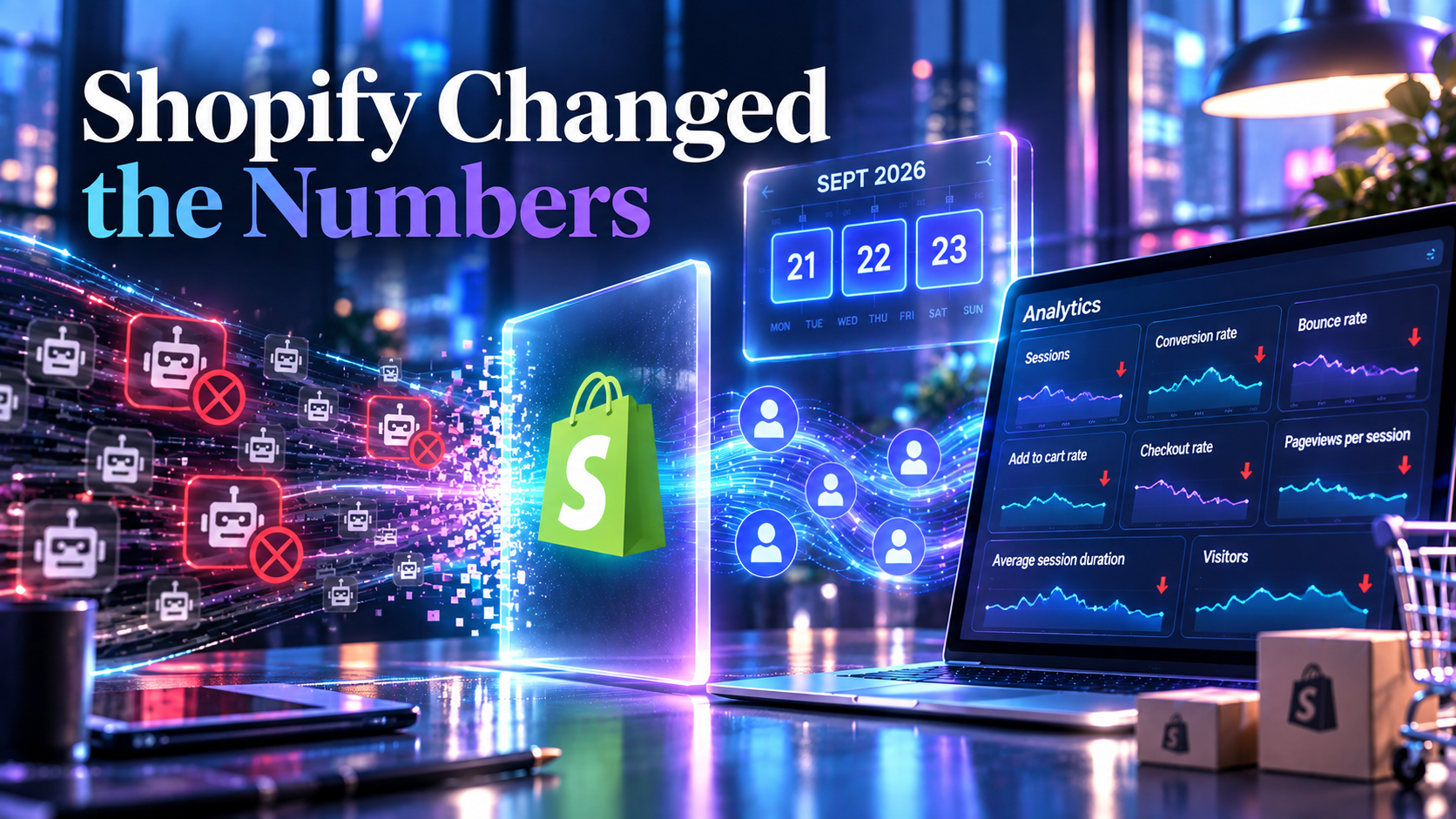
If you run a Shopify store and your conversion rate suddenly changes this week, avoid making a marketing decision based on that number alone. Shopify is rolling out a significant change to the way it measures online-store sessions between September 21 and September 23, 2026, and the update can affect many of the metrics merchants use every day to judge whether their ecommerce business is improving.
The change affects sessions, online-store conversion rate, add-to-cart rate, checkout rate, bounce rate, pageviews per session, average session duration and visitor counts. Shopify is also filtering identified bot sessions out of session-related reporting by default. At the same time, it is changing some of the underlying logic that decides when a session starts and ends.
For a small ecommerce business, this deserves attention because conversion rate often sits at the center of marketing decisions. Owners use it to judge Meta campaigns, Google Ads, landing pages, product changes, promotions, website redesigns and even whether an agency is doing a good job. If the definition of the denominator changes, the KPI changes too.
That does not make the new data less useful. In several ways, Shopify’s updated measurement should provide a cleaner picture of what real customers are doing. It does mean September 2026 needs to become a clear line in your reporting.
Shopify is changing three important things
The first change is how Shopify handles sessions that continue across midnight UTC. Previously, activity crossing that boundary could be split into separate sessions. Shopify will now base the session on continued customer activity, with a session ending after 30 minutes of inactivity.
This should make the measurement better reflect an actual customer visit. A shopper browsing at 23:58 UTC and continuing to shop five minutes later has not meaningfully started a second shopping journey just because the clock crossed midnight.
The second change is that Shopify can now count some legitimate customer sessions even when there was no normal pageview. Shopify gives the example of a customer going directly to checkout through a cart link. That customer is clearly interacting with the store and potentially making a purchase, even though the journey does not look like a traditional visit that starts on a product or collection page.
The third change is probably the one most merchants will notice first: identified bots are filtered from session-related reports by default. Shopify already had the ability to classify traffic as human or bot in supported reports. The new measurement makes the human-focused view the normal reporting experience.
These changes can pull session counts in different directions. Removing bot traffic can reduce sessions. Counting previously missed customer journeys can increase sessions. Combining activity across midnight can reduce the number of sessions attributed to the same shopper.
Your individual store could therefore see conversion rate rise, fall or remain relatively stable.
Conversion rate can move without a single extra order
Conversion rate is calculated using sessions, so changing session measurement changes the percentage.
Imagine a small Shopify store generates 100 orders from 5,000 reported sessions. Its conversion rate is 2%.
Now imagine Shopify identifies 1,000 of those sessions as automated traffic and removes them from the normal session report. The business still has 100 orders, but they are now being measured against 4,000 sessions. The reported conversion rate becomes 2.5%.
Nothing happened to the checkout.
No new marketing campaign launched. The product did not become more attractive. The landing page did not improve. Customers did not suddenly become 25% more likely to buy.
The measurement became cleaner.
A store can experience the reverse as Shopify begins counting legitimate sessions that previously went unmeasured. If sessions increase while orders remain the same, conversion rate falls even though business performance has not deteriorated.
This is why the first recommendation for every Shopify merchant this week is very simple: annotate the change in your reporting.
September 21 should become a marker in your analytics
If I were running reporting for a Shopify SMB, I would put a visible note into every relevant dashboard saying:
Shopify session measurement changed September 21-23, 2026. Session-based KPIs before and after this period are not directly comparable.
That note should exist in Looker Studio, spreadsheets, agency reports, internal dashboards and anywhere else where Shopify conversion rate is tracked over time.
Shopify itself recommends using data after the update as a new baseline for session-based metrics. Historical data is not being deleted or fully recalculated using the new methodology, so simply looking at a year-over-year chart can produce a misleading comparison.
This matters especially as we head toward Q4.
A retailer might compare Black Friday 2026 with Black Friday 2025 and see a materially different conversion rate. Some of that difference may be genuine. Some may come from cleaner bot filtering and the new session methodology.
Revenue, orders, average order value and actual customer counts therefore become even more important when evaluating year-over-year performance.
Small businesses should separate business KPIs from measurement KPIs
This update is a useful reminder that ecommerce businesses should not let one percentage become the definition of success.
I would divide the core dashboard into two groups.
The first contains actual business outcomes: revenue, orders, new customers, returning customers, gross margin, contribution margin, refunds and customer acquisition cost.
The second contains behavioural and diagnostic metrics: sessions, conversion rate, add-to-cart rate, checkout rate, bounce rate and session duration.
The second group helps explain what is happening. The first group tells you whether the business is actually making progress.
If Shopify reports conversion increasing from 2.1% to 2.5% this week while revenue, orders and customer counts remain almost identical, the first question should be whether the measurement update explains the change.
Shopify explicitly recommends comparing orders, sales and customer counts alongside sessions for exactly this reason.
Paid advertising teams need to be particularly careful
This update can easily create bad PPC decisions if teams react too quickly.
Imagine an ecommerce brand spending €5,000 per month on Meta and Google Ads. Shopify conversion rate jumps from 1.8% to 2.2% after the update.
Someone could conclude that campaign quality improved, increase budgets and tell the client that the new creative strategy is working.
The better approach is to check whether actual outcomes changed. Did paid campaigns produce more orders? Did revenue increase? Did cost per acquisition improve? Did blended ROAS improve? Did Shopify simply report fewer sessions because automated traffic disappeared from the denominator?
The same logic applies if conversion rate falls.
Do not pause a successful campaign because Shopify’s session count increased after legitimate checkout journeys started being captured differently. Look first at campaign-attributed purchases, actual Shopify orders, revenue and acquisition cost.
For agencies, I would proactively explain this change to ecommerce clients rather than waiting for someone to notice a strange percentage in the monthly report.
Bot filtering could make channel analysis much more useful
The bot component is particularly interesting for SMB marketers because automated traffic has become a much larger analytics problem.
Shopify itself noted earlier this year that automated traffic can distort conversion rates, inflate apparent traffic and create strange patterns in acquisition reports. Some bots crawl product information, some test websites, some interact with carts and checkouts, and others are useful crawlers from search engines or AI systems.
In supported Shopify reports, merchants can use the Human or bot session dimension to view human sessions, bot sessions or both. Shopify’s own example shows how dramatically interpretation can change: an overall conversion rate can hide materially different conversion behaviour between human visitors and automated traffic.
This is valuable for marketing analysis.
Suppose your direct traffic suddenly increases by 40% while orders barely move. Breaking that traffic down by human and bot session could reveal that much of the spike came from automation rather than a sudden explosion in brand awareness.
The same analysis can help when a referral source appears to deliver huge amounts of low-converting traffic. Before deciding that the channel is useless, check how much of the traffic Shopify identifies as automated.
For a small business with limited marketing resources, removing noise from those decisions is genuinely valuable.
Do not throw away bot data completely
I would still keep an eye on bot traffic rather than hiding it permanently.
Automated traffic itself can contain useful information. A sudden increase may indicate scraping, automated inventory monitoring, testing, spam or another technical issue. Some automated traffic can also come from legitimate search-engine and AI crawlers.
Shopify allows merchants to add the Human or bot session dimension to supported reports, which makes it possible to analyze the two groups independently.
My practical setup would be to use human traffic as the default when evaluating customer behaviour and conversion performance, while maintaining a separate monthly bot-traffic view for technical and marketing monitoring.
That gives you a cleaner commercial dashboard without making the automated part of your audience invisible.
CRO tests need a fresh baseline too
Conversion-rate optimization is another area where this update matters.
Suppose you changed a product-page template on September 15 and planned to compare the following two weeks with the previous period. Your experiment now crosses a major analytics measurement change.
That comparison is compromised.
For important CRO decisions, I would either rely on an experimentation platform whose measurement is unaffected by Shopify’s session change or restart the baseline after Shopify’s rollout is complete.
The same applies to site redesigns, new checkout flows, merchandising changes and promotional tests.
A 12% improvement in conversion rate means very little if the two comparison periods are measured differently.
Agencies should audit custom dashboards and connected apps
Shopify also warns that apps using session data from Shopify Analytics may see their data change. Custom reports using sessions can be affected as well.
That matters because many established Shopify stores do not actually consume analytics directly from the Shopify dashboard. Their data may feed into dashboards, BI tools, attribution products, reporting systems or agency templates.
If you have a custom reporting stack, check it this week.
Look specifically for metrics using Shopify sessions as a denominator. Conversion rate is the obvious one, but add-to-cart rate, reached-checkout rate, checkout conversion rate, bounce rate, pageviews per session and average session duration can all move.
For agencies managing many Shopify clients, I would add a temporary QA task across every account rather than discovering the issue during October reporting.
Headless Shopify stores deserve extra attention
Shopify notes that some headless storefront implementations can behave differently depending on how storefront analytics have been implemented. Merchants using Hydrogen or a custom headless architecture may also need to check cookie handling and session tracking.
Most normal Shopify merchants do not need to make a technical change. A business with a custom frontend should involve whoever maintains that implementation, particularly if Shopify has surfaced a warning about the storefront.
This is one of those situations where a five-minute technical check is much cheaper than spending three months making decisions from incorrect analytics.
My recommended SMB checklist
For most Shopify businesses, I would make seven changes immediately.
First, mark September 21-23 as a measurement-change period in all dashboards and reports. Second, establish a new post-update baseline for conversion rate and other session metrics once the rollout is complete. Third, use revenue, orders and customer counts to verify whether apparent performance changes represent actual business changes. Fourth, keep the same Human or bot session setting whenever you compare two periods.
Fifth, review paid media performance using acquisition cost, revenue and orders before reacting to any sudden Shopify conversion-rate change. Sixth, audit custom dashboards, apps and agency reports that rely on Shopify session data. Seventh, avoid using experiments that cross the rollout period as clean evidence of a CRO improvement or decline.
None of these steps requires a complicated analytics project. They simply prevent a measurement change from becoming a business decision.
The bigger lesson is that clean data matters more as marketing becomes automated
Shopify’s update arrives at an interesting moment. Google Ads, Meta, Shopify and other marketing systems increasingly use automated bidding, AI-generated campaigns and algorithmic decision-making. Small businesses are being encouraged to let machines make more operational marketing choices.
That makes measurement quality more important.
If the underlying analytics includes a large amount of automated traffic, optimization systems and human marketers are both working from a distorted picture. Cleaner separation between genuine shoppers and automated visitors should give merchants a more realistic understanding of how their stores perform.
I see Shopify’s change as a positive improvement. Counting legitimate customer journeys more accurately, treating continuous activity as one session and filtering known automated traffic by default should make the numbers closer to the thing merchants actually care about: how real customers behave.
The important job for SMB owners is making sure the transition itself does not create false conclusions.
From the end of September onward, treat Shopify’s new session methodology as the beginning of a fresh measurement baseline. Keep older numbers for historical context, keep revenue and customer outcomes at the center of your decision-making, and make sure everyone looking at your analytics understands why that line exists.