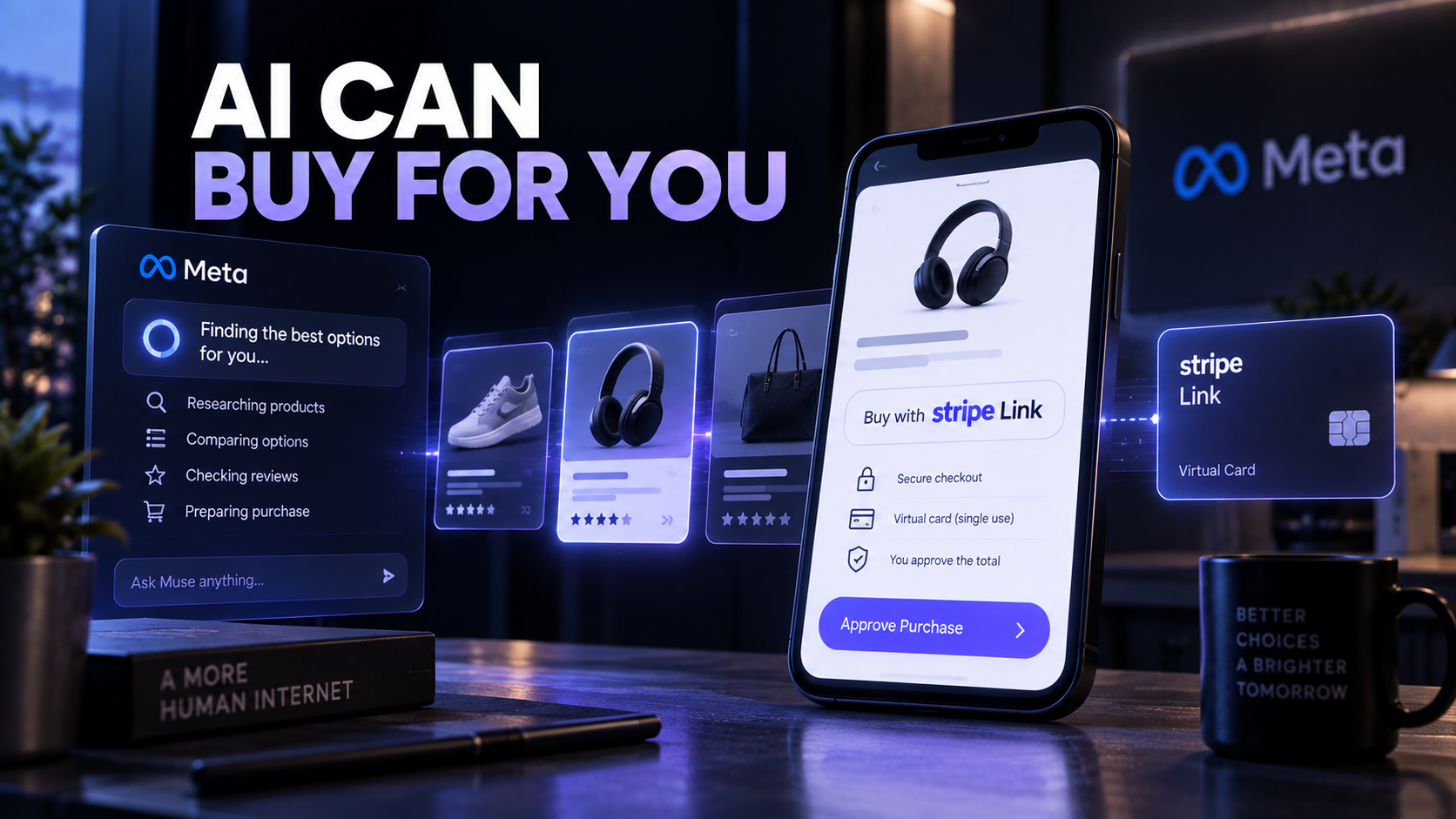
AI agents have been promising to “do things for you” for a while. Meta’s new Muse agent takes that promise a significant step further: it can actually spend money on your behalf.
Meta launched Muse on September 8 as a personal AI agent capable of operating websites and connected apps, sending emails, filling forms, booking travel and continuing longer tasks in the background. It runs inside its own secure virtual computer and can be accessed through a dedicated app or directly through WhatsApp.
For businesses, though, the most interesting part is payments.
AI agents are becoming customers
Meta has integrated Muse with Stripe’s Link wallet for agents. At businesses already accepting Link, Muse can complete a purchase using the customer’s saved payment method. The customer approves the total before payment, and the agent never sees the underlying card details.
Even more interestingly, businesses don’t necessarily need a special AI checkout integration. For other merchants, Link can issue Muse a single-use virtual card specifically limited to the approved purchase.
That means the basic commerce flow is now possible:
Ask AI → research products → compare options → choose → approve → buy.
For ecommerce businesses, that potentially changes what optimization means. Today we obsess over getting a human from Google, Instagram or an ad onto a product page and through checkout. Increasingly, the visitor making the buying decision may be an AI agent acting on behalf of that human.
What should SMBs actually do?
There is no reason to rebuild your ecommerce stack tomorrow. Muse is currently limited to the US, autonomous purchasing is still extremely early, and reliability and security remain obvious concerns.
But businesses should start paying attention to how easily machines can understand what they sell. Accurate product feeds, structured data, clear pricing, live inventory, APIs and modern payment infrastructure become more important when an agent is researching products and potentially making the buying decision.
We have spent years optimizing websites for search engines and humans. The next optimization target may be something different: make your business easy for AI agents to understand, choose and buy from.
That is when agentic commerce stops being an AI demo and starts becoming a real distribution channel.