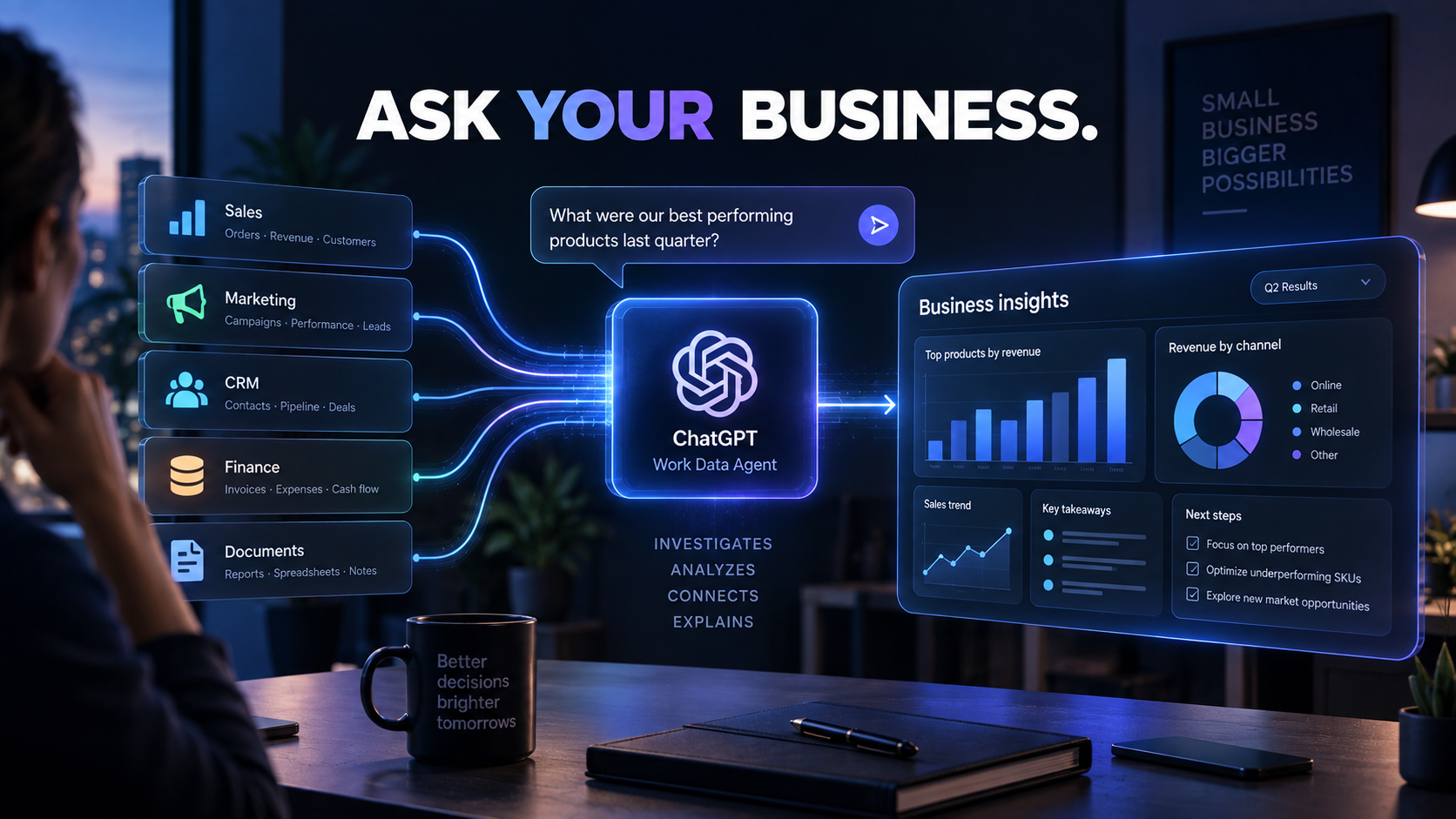
Small businesses usually don’t have a data problem. They have an “actually getting useful answers from the data” problem.
Sales numbers sit in one system. Marketing performance is somewhere else. Customer information lives in a CRM. Finance has spreadsheets. Operations has another spreadsheet. Google Drive contains years of documents nobody remembers creating.
Large companies solve this by hiring analysts and building expensive business intelligence infrastructure. Small businesses mostly solve it by opening five browser tabs and exporting another CSV.
OpenAI’s new Data agent for ChatGPT Work could make that gap considerably smaller.
The Data agent connects ChatGPT directly to business data sources including BigQuery, Snowflake, Databricks, MongoDB, Amazon Redshift and ClickHouse, alongside everyday business tools such as Google Drive and Microsoft SharePoint.
You can then ask a business question in normal language rather than figuring out which database, spreadsheet or dashboard contains the answer.
That difference is important.
Imagine a 15-person ecommerce business asking:
“Why did revenue drop last month?”
Answering that properly might require checking sales data, advertising performance, product information, customer behaviour and previous reports. Normally, someone has to gather that information manually before they can even start analysing it.
A data agent can investigate across connected sources, determine what information it needs, analyse the results and produce an interactive dashboard explaining what it found.
For a small company without a dedicated analyst, that is potentially a significant productivity upgrade.
It also changes who can ask sophisticated questions.
The owner can investigate which customers are becoming less active. A marketing manager can compare campaign spending against actual revenue instead of platform-reported conversions. A small agency can analyse performance across clients. A SaaS founder can investigate churn patterns without writing SQL.
You don’t necessarily need to know where the answer lives before asking the question.
That is the bigger shift.
Traditional business intelligence expects companies to decide what they want to measure first. Someone builds the database queries, reports and dashboards, and everyone subsequently looks at those predefined metrics.
Agents can reverse that workflow.
Start with the business question and let the system work out which data it needs.
OpenAI says the technology behind Data agent is already used extensively inside the company. Nearly all of its product organization and more than two-thirds of its go-to-market organization reportedly use its internal data agent.
For small businesses, however, there may be an even bigger relative benefit.
A 500-person company saving an analyst a few hours is useful. A 10-person company gaining analytical capabilities it previously couldn’t justify hiring for can change how that company operates.
It doesn’t mean your accountant, marketing specialist or experienced analyst suddenly becomes unnecessary. The agent can find correlations and patterns, but someone still needs enough business context to decide whether those findings make sense and what to do about them.
Data access also needs to be handled carefully. Connecting an AI system to financial, customer and operational information requires proper permissions. Employees should see only the information they’re supposed to see, and sensitive decisions should still have human oversight.
But the practical opportunity is compelling.
Small businesses already generate enormous amounts of useful information. Stripe, Shopify, WooCommerce, Google Ads, Meta Ads, CRMs, accounting platforms, support systems and spreadsheets continuously produce data.
The problem has always been turning it into decisions without building a miniature data department.
Tools like ChatGPT Data agent suggest that the interface to business intelligence may eventually become remarkably simple:
Ask your company a question or a dozen.
Then let the AI figure out where to look.
For SMB owners, that could be much more valuable than another chatbot that writes better emails.