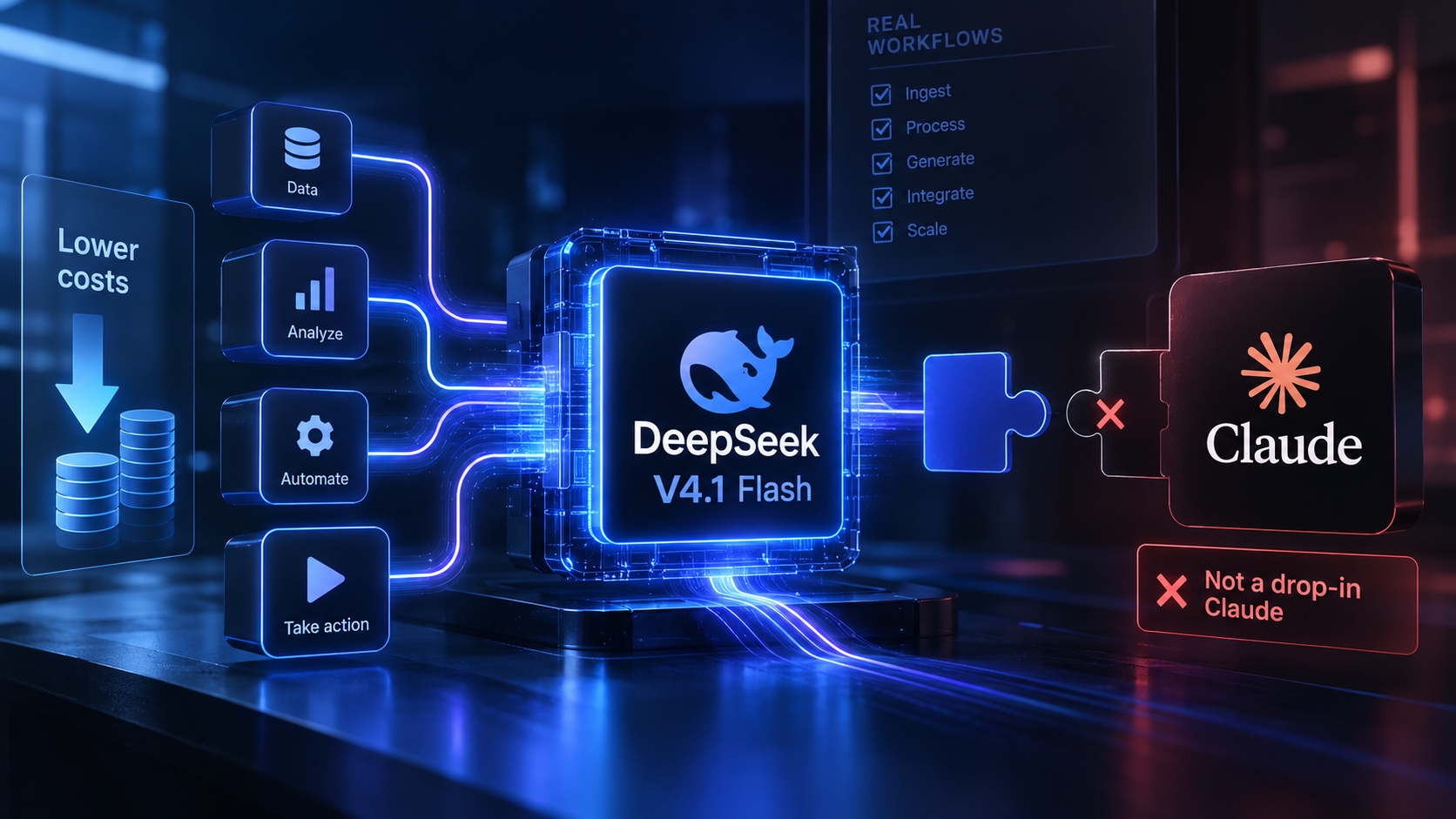
DeepSeek shipped V4.1 Flash on 10 September: 552B MoE, native image input, 1M context, MIT weights. Prefill activates about 8B parameters, decode about 16B. They are routing old V4 Pro traffic onto it from 14 September because, on their numbers, Flash already wins on cost, speed and runtime.
For an agency or SMB desk the useful question is not “is this AGI.” It is whether you can afford to let an agent loop ten times on a quote, a catalog cleanup or an n8n draft.
Price first. Gemini is the honest comparison.
Gemini 3.8 Flash (same list as 3.7 Flash through 31 December 2026) is $0.75 input and $3.75 output per million tokens. Output includes thinking tokens, so a “smart” run is more expensive than the list suggests.
DeepSeek V4.1 Flash at peak is $0.30 input / $1.20 output. Off-peak (weekends and most weekday hours) is $0.15 / $0.60. Cache hits drop to $0.003 off-peak. That is roughly 2-6x cheaper than Gemini Flash on raw miss pricing, and an order of magnitude cheaper once a workflow reuses the same system prompt and docs.
Frontier intelligence is a different bill. Claude Fable 5.1 sits at $10 / $50. GPT-6 Astra is in the same band. Claude Opus 5 is $5 / $25. Grok 4.5 / 4.6 is $2 / $6. One million in plus one million out is about $0.75-$1.50 on DeepSeek Flash, $4.50 on Gemini Flash, $8 on Grok, $30 on Opus, $60 on Fable/Astra.
If you are building a workflow that classifies leads, rewrites product copy, tags invoices or retries a tool call, token volume is the product. Cheap tokens change what you can ship.
Intelligence second. Do not confuse “good on a bench” with “same model.”
DeepSeek’s own table puts V4.1 Flash next to GPT-5.6 Sol and Claude Opus 5 on some agent and coding scores (DeepSWE 74.2 vs 74.0 / 73.0; Automation-Bench ahead of both). That is enough for draft-and-retry work. It is not enough to assume it matches Claude, GPT-6 Astra or Grok on long messy judgement: contracts, brand voice under pressure, multi-step exception handling, “should we send this to the client.”
Grok and the US frontier models still win when the task is one hard pass, not fifty cheap ones. Gemini Flash sits in the middle: more expensive than DeepSeek, easier procurement, better default product surface if you already live in Google.
Use DeepSeek where volume and iteration pay the bill. Use Claude / GPT / Grok where a single bad answer is expensive.
Safeguards are the part people skip, then regret.
Hosted DeepSeek processes data under Chinese jurisdiction. China has no EU adequacy decision. Public enterprise DPA / SCC packages are not in the same class as Anthropic, OpenAI or Google Cloud. Italy already moved on DeepSeek over transfers. This week US agencies named DeepSeek in an industrial-scale distillation advisory; Anthropic separately says Chinese labs routed customer traffic through Claude. None of that makes the weights illegal. It does mean the hosted API is a poor place for client PII, HR files, contracts or anything you would not put in a Chinese SaaS inbox.
Open weights change the shape of the risk: you can run the model on EU iron and keep prompts local. That is the responsible path for production. The $0.003 cache rate is the hosted convenience path. Do not mix them up.
Also: cheap models refuse less cleanly and leak more when you give them tools. If the agent can send email, write to WooCommerce or touch a CRM, put the permission layer in your stack. n8n scopes, allowlists, human confirm on send. The model will not save you.
What to do this week
- Price one real loop (lead triage, product description batch, support draft) on DeepSeek off-peak vs Gemini 3.8 Flash vs Claude. Use your actual token counts, including retries.
- Keep customer-facing and personal-data steps on Claude, GPT or a EU-hosted Gemini/Vertex path.
- If DeepSeek wins on cost, self-host or isolate it behind a gateway that strips PII. Do not paste client folders into chat.deepseek.com and call it a system.
Cheap models make workflow building viable for small teams. They do not inherit Claude’s brakes, Google’s contract paper or OpenAI’s enterprise defaults. Route by risk, not by the leaderboard screenshot.