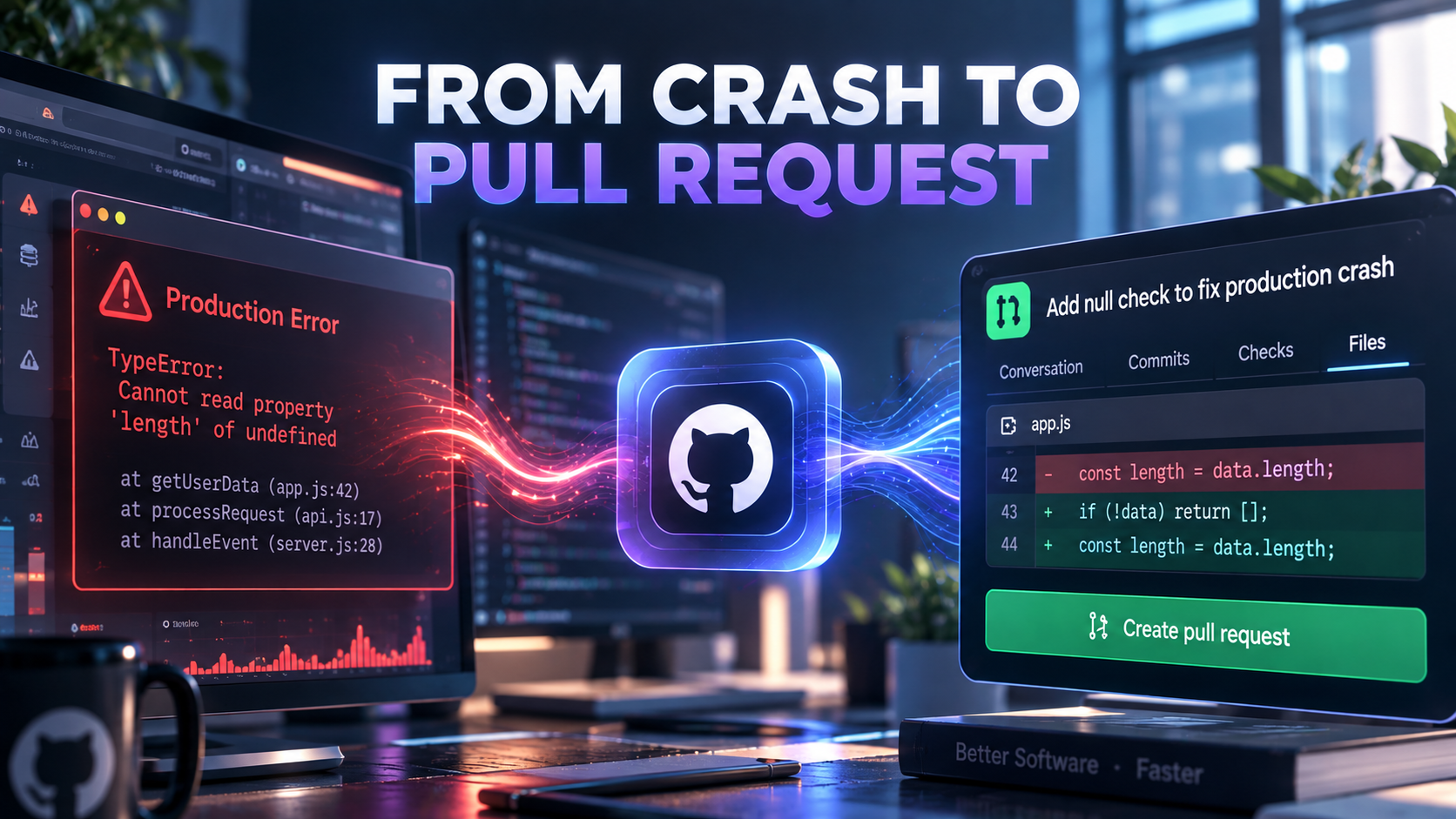
When a production application breaks, writing the fix is often only a small part of the job.
Someone has to notice the error, open the monitoring system, understand the stack trace, find the relevant code, work out what changed, reproduce the problem, create a fix, run tests and prepare a pull request.
For a solo developer or small software team, that interruption can consume a surprisingly large part of the day.
GitHub has just connected more of that process together. The GitHub Copilot app now includes a Sentry canvas that lets Copilot pull production errors, stack traces and related context into the coding workflow, investigate what caused the problem, validate a fix and prepare a pull request.
For SMBs building software, this is one of the more practical developments in coding agents because it targets maintenance work that every real application eventually creates.
The agent gets the context before it starts coding
Imagine you run a small SaaS product.
Sentry reports a spike in checkout errors after a deployment. Traditionally, you open Sentry, inspect the error, copy the stack trace, find the relevant repository, locate the affected code and start investigating.
If you want AI assistance, you then need to transfer enough of that context into your coding tool for the model to understand what happened.
The new Sentry integration reduces that context-moving work.
Inside the Copilot app, the Sentry canvas can expose the error report, stack trace and related information directly to Copilot. You can then work with the agent to investigate the cause and prepare the code change.
That creates a much tighter workflow:
Production crash → Sentry context → Copilot investigation → proposed fix → validation → pull request
The human still reviews the result and decides what reaches production.
For small development teams, the important improvement is how quickly you can move from “something is broken” to “here is a reviewable fix.”
Maintenance is a huge SMB development cost
AI coding demos often focus on building something new. Real software businesses spend an enormous amount of time maintaining what they already built.
Dependencies break. APIs change. Customers discover edge cases. Deployments introduce regressions. Browsers behave differently. Payment providers return unexpected responses. Data contains combinations nobody considered when the feature was written.
Large engineering organizations can have dedicated teams for reliability, QA and production operations.
A five-person SaaS company may have two developers.
A solo founder may have one person responsible for features, infrastructure, support and production incidents: themselves.
This makes maintenance an especially valuable place for AI agents.
Saving 15 minutes generating a component is useful. Reducing the amount of investigation required every time production throws an unfamiliar error can change how much software a small team can realistically maintain.
Copilot is also getting better at reviewing the fix
GitHub’s September 18 release included several improvements to Copilot code review that fit neatly into this workflow.
Copilot can now distinguish between findings that remain open and problems it previously identified that have since been fixed. During subsequent reviews, it validates whether earlier issues were actually addressed.
It can also use shell tools while reviewing code, allowing it to inspect or validate changes more deeply than a purely text-based diff review. When developers apply eligible Copilot suggestions in a batch, it can generate a commit message for the resulting change.
Put those pieces together with Sentry and the workflow becomes increasingly complete.
The agent can investigate the production problem, help prepare a change and participate in reviewing whether the proposed fix actually addresses the issue.
That is much closer to the work a developer performs during a real incident.
A small ecommerce business is a good example
Imagine a WooCommerce or custom ecommerce application where customers occasionally encounter an error while applying a discount code.
The issue only happens when a particular promotion is combined with a certain customer state, so the development team hasn’t reproduced it locally.
Sentry captures the production exception.
Copilot can inspect the report and stack trace, connect it to the relevant code and start investigating the likely cause.
It might identify that a value assumed to exist is occasionally null, trace how that state occurs and propose a safer implementation. The developer can review the reasoning, run the relevant tests and inspect the pull request.
The entire process still requires technical judgment.
What changes is the amount of mechanical investigation needed before that judgment becomes useful.
For a small agency maintaining twenty client applications, that can compound quickly. Even modest reductions in investigation time across dozens of monthly issues can recover meaningful development capacity.
Solo developers benefit even more
Solo developers have an additional problem: there is nobody else available to pick up the interruption.
If you’re working on a new feature and a production error appears, your attention immediately changes direction. You need to rebuild enough context around an older part of the application to understand what is happening.
An agent already connected to the repository and production error can shorten that restart considerably.
This is also where AI coding tools are moving beyond the role of autocomplete. The useful agent understands more of the software lifecycle: issues, repositories, CI, monitoring, reviews and pull requests.
The more of that environment it can access safely, the less time the developer spends copying information between systems.
There are limits you should take seriously
Production debugging deserves more caution than generating a landing page.
An agent can misunderstand a stack trace. It can fix the symptom while leaving the underlying problem. A technically valid change can still create a business problem elsewhere.
For that reason, I would keep human review firmly inside this workflow.
I would also make automated tests a requirement before giving coding agents greater autonomy. If your application has poor test coverage, the agent has fewer reliable ways to establish that its fix didn’t break something else.
This makes AI development and basic software engineering discipline increasingly connected. Good tests, reproducible environments, clear logs and small pull requests make coding agents much more useful.
What I would test
If you already use Sentry and GitHub Copilot, connect them and start with low-risk real incidents.
Don’t manufacture a toy bug.
Take an actual production issue with a clear stack trace and see how much of the investigation Copilot can perform. Compare the workflow with how you normally debug the same type of problem.
Measure three things:
Time from Sentry alert to identified cause.
Time from identified cause to reviewable pull request.
How much human correction the proposed fix requires.
Those metrics tell you far more than how impressive the generated code looks.
For agencies, I would also test whether this improves maintenance economics. Support retainers and small development requests often contain many short investigations where understanding the issue takes longer than writing the fix.
Why this matters
Coding agents are becoming more valuable as they gain access to the systems surrounding the code.
A production error exists in Sentry. The implementation lives in GitHub. Tests run in development and CI. The result eventually becomes a pull request.
Connecting those stages allows an AI agent to participate in the real workflow rather than receiving carefully prepared prompts from a developer.
For a small development team, that can increase the amount of software each person can support.
My recommendation: If your business builds or maintains software and already uses Sentry plus GitHub Copilot, test the integration now on real, low-risk production errors. Keep pull-request review and deployment approval human-controlled, and invest in tests because they give the agent a much stronger way to validate its own work.