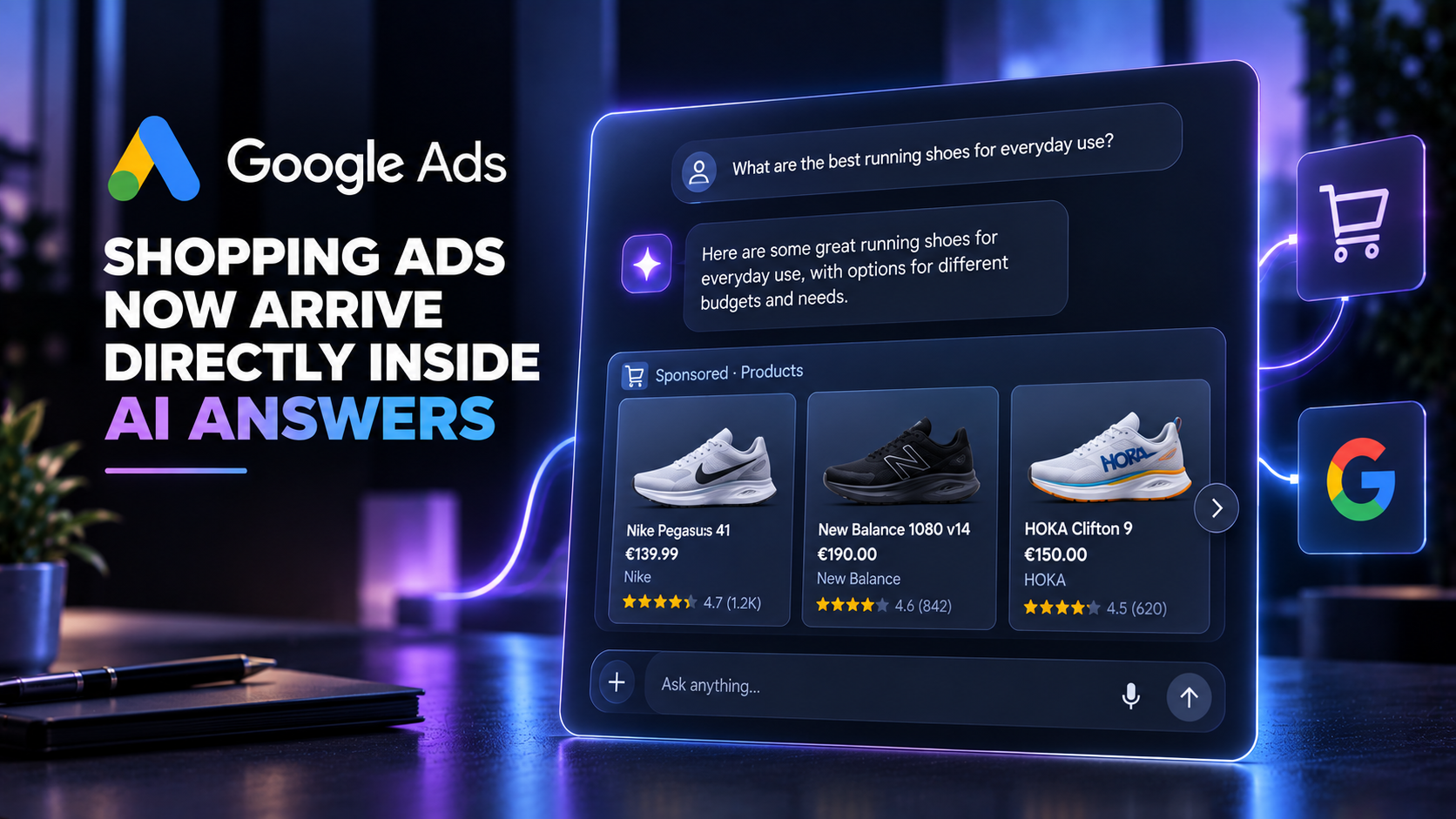
Google’s AI search experience is starting to look a lot more like a storefront, and that could have significant consequences for ecommerce marketing. Shopping ads have now been spotted appearing directly inside Google AI Mode responses, including sponsored product carousels inserted between sections of AI-generated text. Rather than keeping advertising around the edges of an AI answer, Google is experimenting with making paid product discovery part of the answer itself.
Until now, much of the digital marketing conversation around AI search has focused on organic visibility: how brands get mentioned, which websites AI systems cite and whether traditional SEO survives when users no longer need to click ten blue links. Shopping ads introduce another dimension. Brands may increasingly compete for visibility inside AI-generated recommendations through both organic optimization and paid media, potentially turning AI Mode into another performance marketing channel.
The placements were documented on August 31, with screenshots showing product carousels and individual sponsored products appearing inside AI Mode answers, plus additional sponsored results further down the page. Some units go beyond the traditional Shopping ad format. Google can add descriptive product information that fits into the surrounding AI-generated response, making the advertising feel closer to a recommendation than a conventional search ad.
Consider someone asking Google, “What running shoes should I buy for wide feet under €150?” Traditionally, marketers would compete through SEO pages, Shopping results and Search campaigns, then try to get the user onto their website. AI Mode can potentially collapse several of those steps into one experience: understand the buying intent, explain the available options, recommend products and insert sponsored products directly into the recommendation.
For performance marketers, however, there is an important problem: control and attribution are currently limited. Advertisers cannot create a dedicated AI Mode campaign or explicitly bid for these placements. Existing eligible campaigns can appear there automatically, while Google decides when the placement is appropriate. More importantly, advertisers cannot properly isolate AI Mode performance inside Google Ads reporting, making it difficult to know whether these impressions and clicks actually perform differently from conventional Search or Shopping traffic.
That means the immediate opportunity is less about creating a new campaign and more about improving the signals Google already uses. Ecommerce businesses should keep Merchant Center feeds clean, improve product titles and attributes, maintain strong imagery and pricing data, and make sure landing pages clearly communicate product information. The quality of structured product data could become even more important when Google’s AI is deciding which products fit a conversational query.
Marketers should also stop treating SEO, Shopping and AI visibility as completely separate disciplines. If AI Mode becomes a meaningful commercial surface, product feeds, paid search, landing-page quality, structured data, brand authority and content optimized for AI recommendations will increasingly influence the same customer journey.
The bigger trend is hard to miss: Google is not going to let AI search remain an ad-free alternative to traditional Search. It is rebuilding its advertising model inside the AI answer. For ecommerce SMBs and digital marketers, the important question is no longer whether AI search will affect acquisition. It is how quickly Google Ads strategy will need to adapt when the search result itself becomes the storefront.