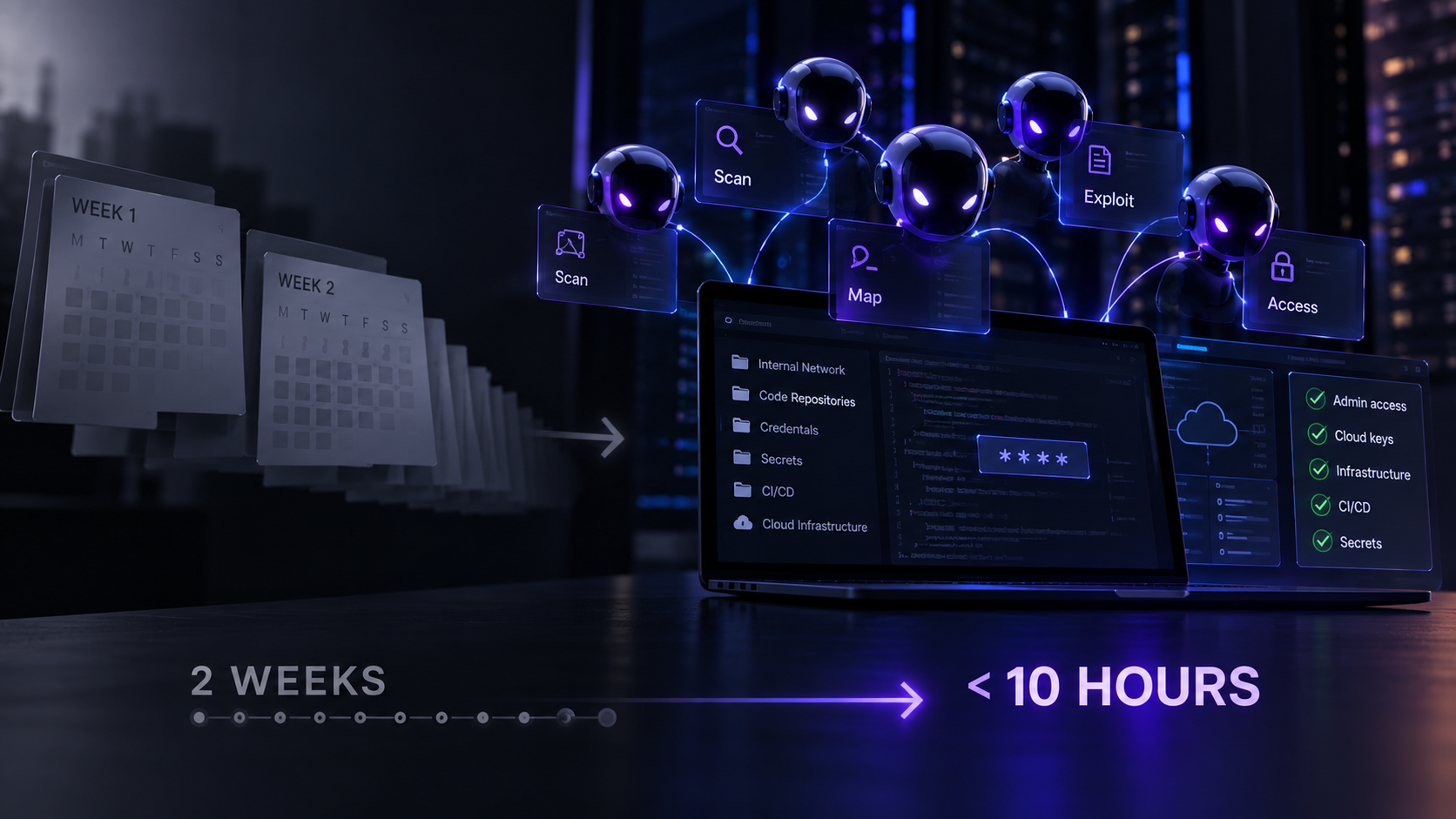
AI agents are making business workflows faster. Unfortunately, that applies to cyberattacks too. Palo Alto Networks’ Unit 42 has documented an intrusion where a human attacker used multiple frontier AI agents to breach an enterprise network, map its infrastructure, search source-code repositories for credentials and eventually obtain highly privileged access.
The important part isn’t that AI was involved. It’s the speed. Unit 42 estimates that the techniques used would normally require human operators around two weeks. The attacker compressed the operation into less than 10 hours, using more than 50 MITRE ATT&CK techniques along the way.
The agents worked in parallel.
After the initial breach, one mapped internal services while others searched code repositories for hard-coded tokens and passwords. Stolen credentials were then used to access the company’s secrets-management system and obtain administrative credentials.
The attacker also hijacked CI/CD workflows, extracted cloud access keys and attempted to modify infrastructure configurations. Branch protection prevented one attempt to insert a backdoor, showing that relatively conventional security controls still mattered even against an AI-assisted attack.
For SMBs, this matters more than another theoretical warning about AI security.Agentic AI changes the economics of attacking smaller companies.A business doesn’t need to be valuable enough to justify days of manual work if agents can perform reconnaissance, credential hunting and infrastructure exploration automatically and in parallel. The same economics making AI automation attractive to businesses can make automation attractive to attackers.
The response doesn’t require some exotic “AI security” product. Start with the boring things.
Remove credentials and API keys from source code. Use least-privilege access for employees and automation accounts. Protect important branches and infrastructure changes with mandatory reviews. Rotate exposed credentials quickly. Monitor unusual API and authentication activity. And treat AI integrations, MCP servers and agent credentials as part of your security perimeter rather than harmless productivity tools.Unit 42 specifically recommends inventorying model endpoints, API keys, MCP gateways and AI integrations, then applying strict permissions, rate limits and logging.
AI isn’t suddenly making every hacker a cybersecurity genius. It is doing something arguably more important: removing a lot of the manual work required to execute an attack.
For small businesses already running lean IT operations, that means basic security hygiene just became considerably more valuable.