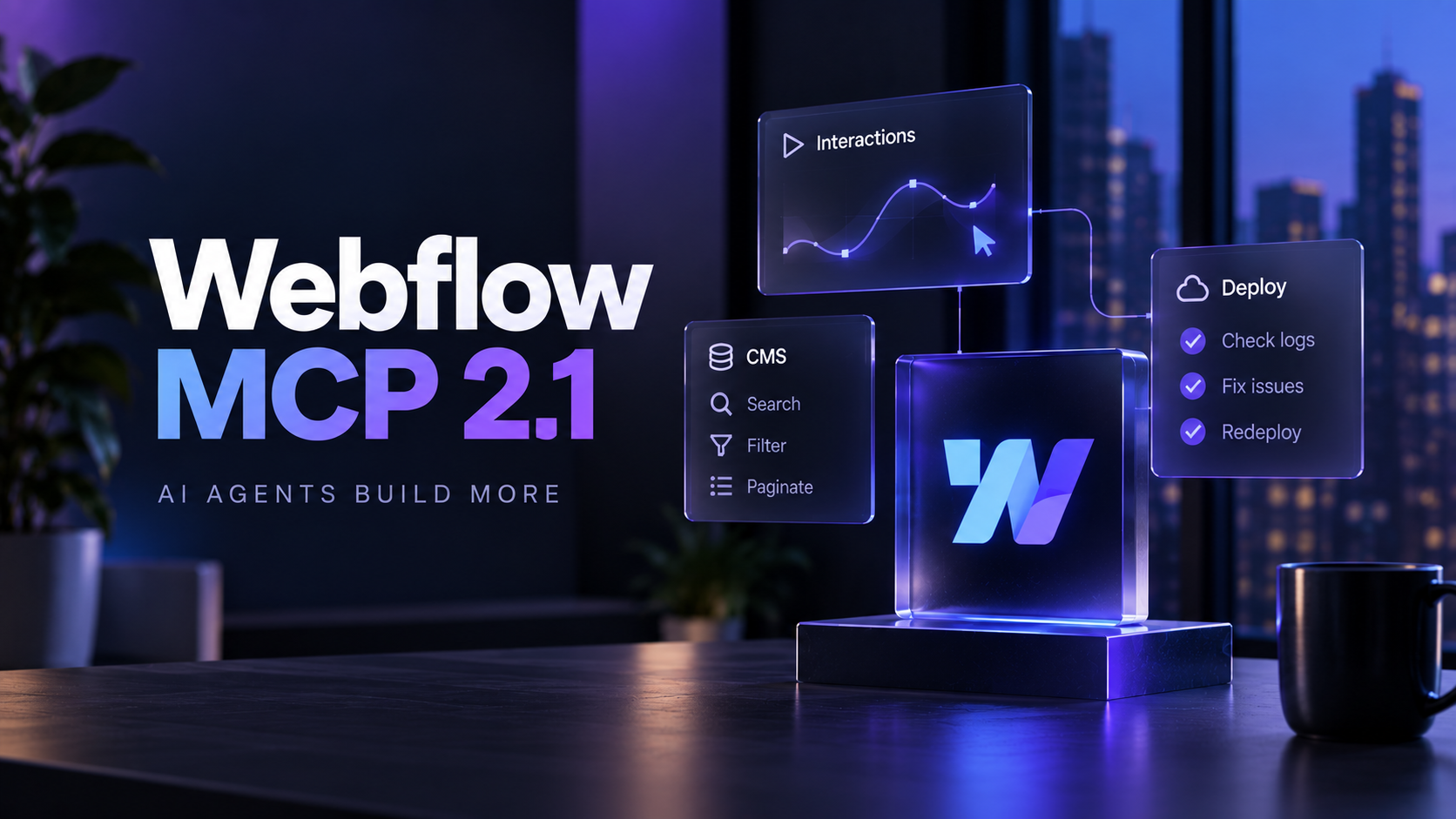
Webflow is giving AI agents considerably more control over websites with MCP 2.1, an upgrade announced at Webflow Conf 2026 that expands what tools like Claude, ChatGPT, Codex and Cursor can actually do inside Webflow. The biggest addition is native GSAP interaction support. Instead of asking an AI assistant to generate animation code that you then have to implement, you can describe the interaction you want and let the agent build it directly. That includes complex timeline-based animations, while keeping Webflow’s visual controls available for manual tweaking.
CMS access is getting better too.
Agents will be able to sort and filter using custom fields, search reference fields and paginate through CMS results. That sounds less exciting than AI-generated animations, but it may be more useful in everyday work. Content audits, bulk CMS operations and finding specific content currently require agents to make multiple requests. Better querying means fewer steps, faster workflows and lower token usage.
Webflow Cloud is also becoming more agent-friendly. Deployment error logs can now be surfaced directly to coding agents, allowing tools such as Claude Code, Codex or Cursor to diagnose a failed deployment, fix the problem and redeploy.For small agencies, freelancers and SMBs, this is where MCP starts becoming genuinely interesting.An AI assistant connected to Webflow is no longer just helping you write copy or generate some CSS. It is gradually becoming capable of operating the website itself.
You could ask an agent to find outdated CMS content, update it according to your brand instructions, build a new landing page, add interactions and help troubleshoot deployment problems without constantly jumping between an AI chat, code editor and Webflow. There are still reasons to keep humans in the loop, especially before publishing production changes. But the direction is clear: websites are becoming infrastructure that AI agents can operate directly.
Webflow says MCP 2.1 will become available to everyone later this month, with access to AEO Analytics and Webflow Optimize planned later.For agencies in particular, this is worth testing as soon as it becomes available.
The interesting question is no longer whether AI can build a website.
It is how much of maintaining and improving that website still needs a human to operate the tools.