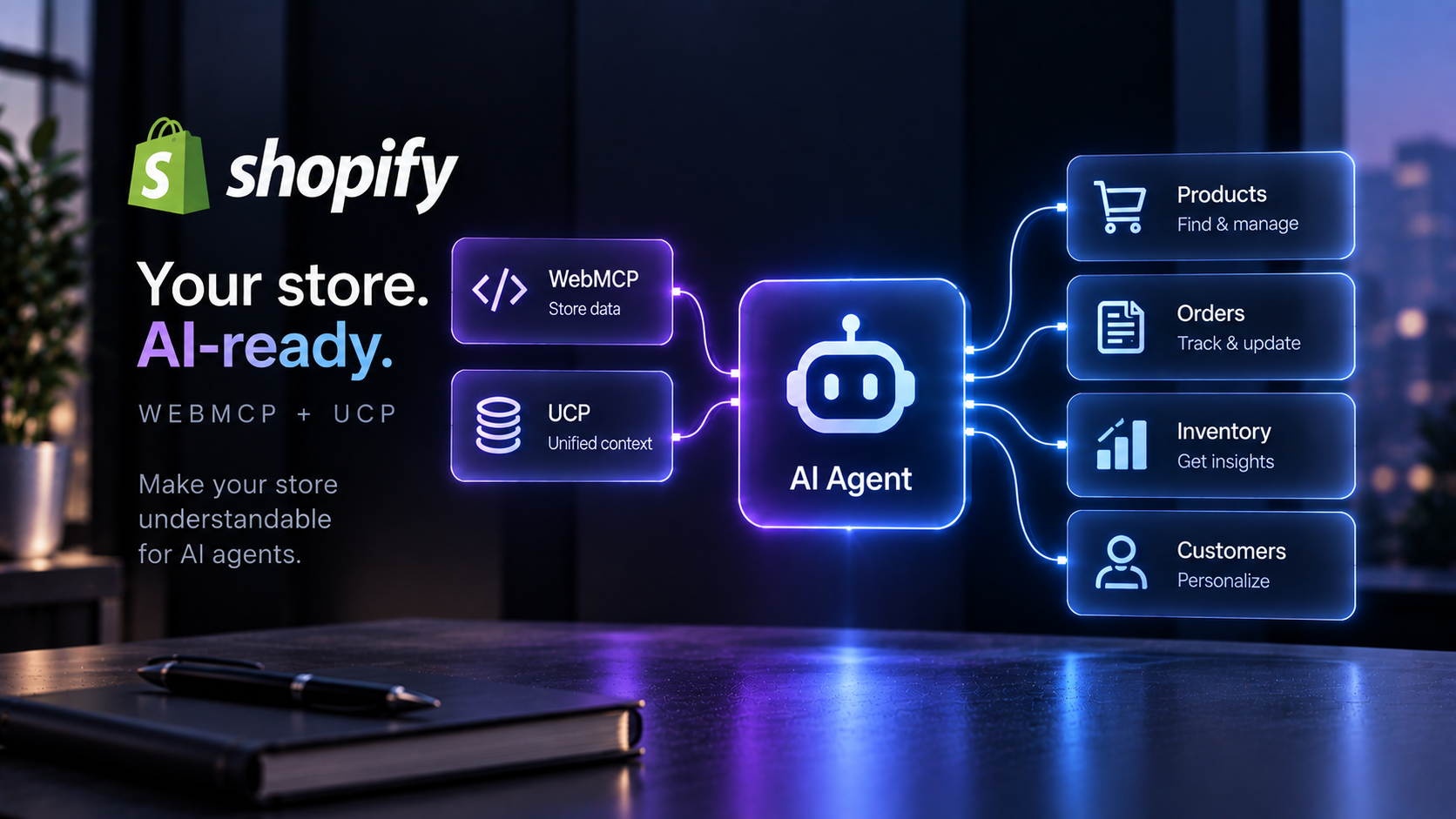
Two quiet Shopify updates mean AI agents can talk to your storefront more cleanly. Most Spanish and EU merchants will not see a traffic spike from either one. Agency pilots and people building shopping agents will.
WebMCP (5 August). Liquid online stores now expose WebMCP tools with nothing to install. On the Hydrogen side, Shopify lists developer preview. In a supported browser tab, an agent can search the catalog, browse products, read variants, manage the shopper’s cart, go to checkout, and search shop policies and FAQs. The important detail: everything runs on the shopper’s live session. Cart updates use the same storefront actions your apps already use, so if your theme opens a cart drawer on change, the agent triggers that too.
WebMCP is still an emerging standard. Shopify says agent support is currently limited to Chromium-based browsers via an origin trial, and that it is shaping the spec with Google and Microsoft. That is not “AI shoppers overnight.” It is structured tools instead of brittle click-simulation, for the agents that already know how to call them.
UCP 2026-08-25 (4 September). Storefronts now advertise that protocol version in /.well-known/ucp. Capabilities are unchanged. Merchants do not flip a switch. Platforms and agents that speak the 2026-08-25 profile can negotiate with Shopify storefronts using that version. Discovery is not foot traffic. If you are buying or building an agent storefront, check that it actually uses catalog capabilities such as search_catalog / Catalog MCP. Do not stop at “the discovery file exists.”
Keep this separate from the ScriptTag cliff (create/update blocked 1 October; injection ends 1 March 2027). That is pixel and script migration. This piece is about agent storefront plumbing.
For a Spanish Shopify merchant, the useful work is ordinary catalog hygiene that agents amplify: clear titles and variants, accurate stock and shipping copy, policies and FAQs that search_shop_policies_and_faqs can return without surprises. GDPR-wise, agent actions ride the shopper’s session and consent state. Dirty product data or a messy cart drawer becomes the agent’s UX too.
What to do this week: open your store on a Chromium origin-trial setup if you want to see WebMCP tools; open yoursite.com/.well-known/ucp and note the advertised version; decide whether you want agents to reach checkout, or only browse and FAQ; fix the product and policy pages an agent would hit first. Agent-callable storefronts are real. Discovery alone does not send customers.